A path of dark, fragrant coffee grounds winds its way through a historic pavilion in Gwangju. Along the path, brightly coloured Inuit boots move forward – traces of three generations of Greenlandic women. At the 16th Gwangju Biennale, Jessie Kleemann gathers the footsteps of her foremothers and listens to a land beginning to stir.
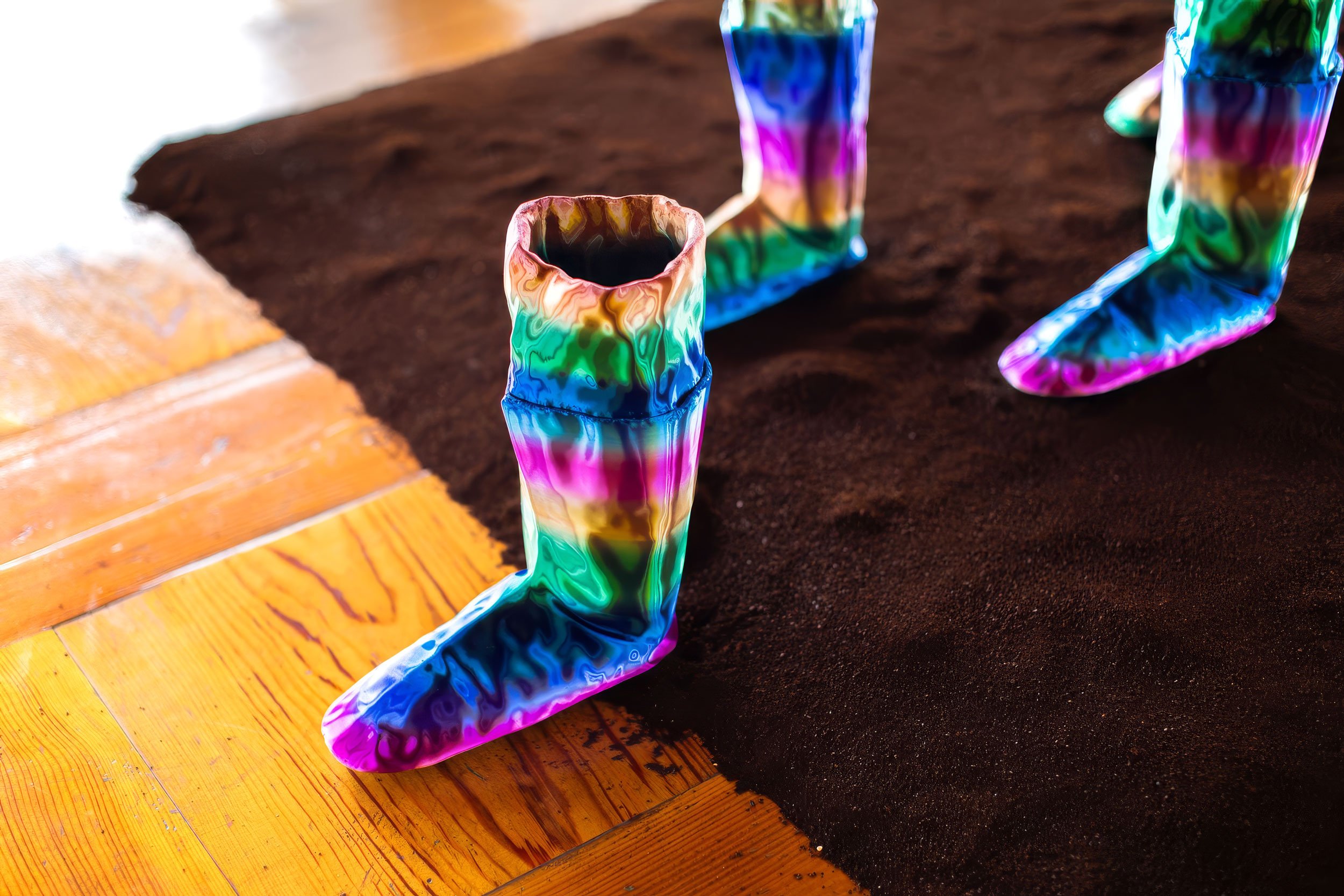
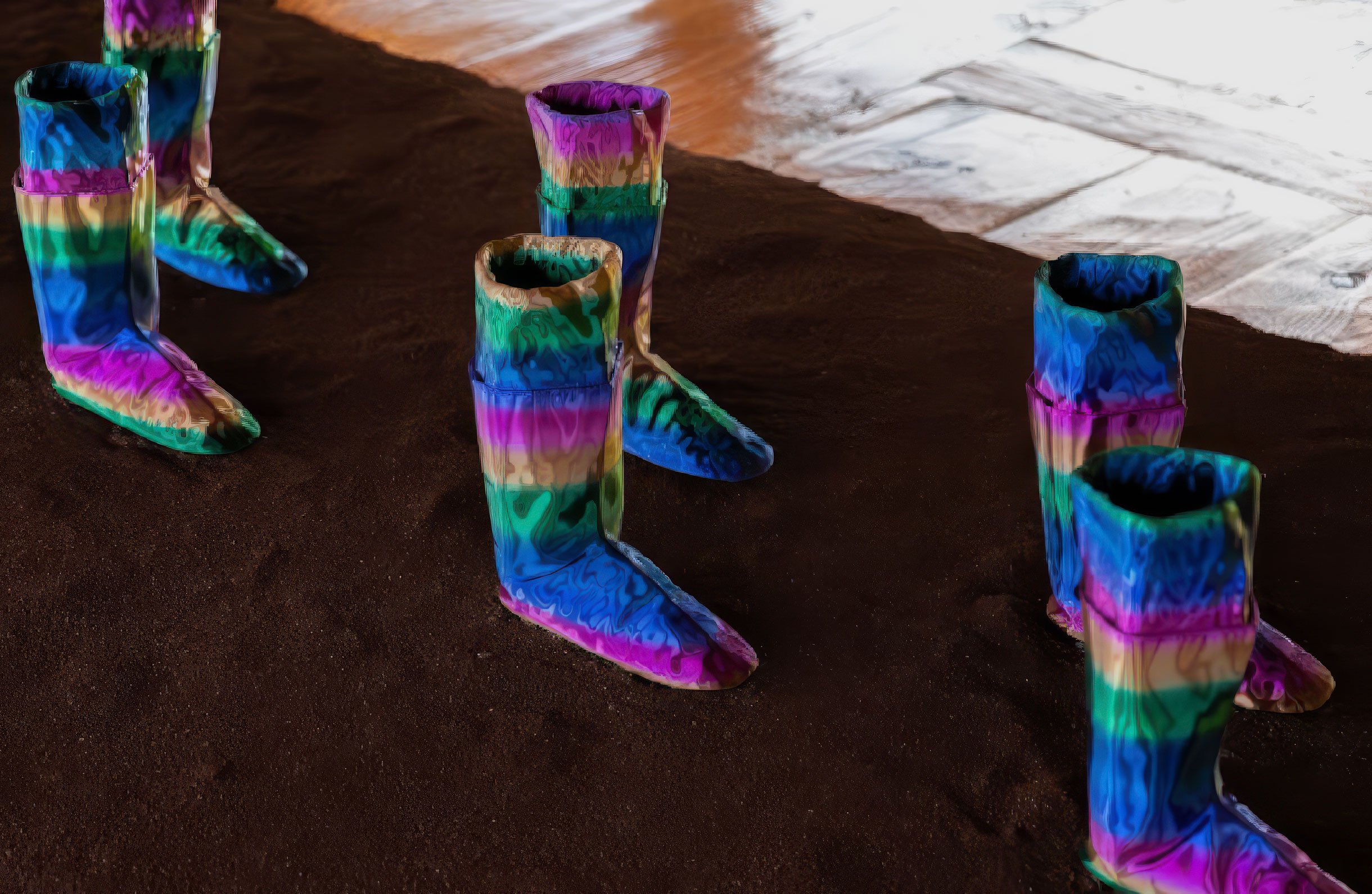
Inside Heekyungru, a historic wooden pavilion in Gwangju, a line of kamiit (traditional Inuit boots) makes its way along a path of dark and fragrant earth. The earth is coffee, 175 kilograms of it, laid with a soft, organic edge like a trail worn into the ground.
The boots shimmer in violet, green, blue and golden hues, each color melting softly into the next. Each is a replica of a boot from the same pair of sealskin kamiit, worn thin by decades of use and passed from Kleemann’s grandmother to her mother and then to her. 3D-scanned and printed in biodegradable plastic, the copies preserve every crease and fold that three generations of walking have pressed into the skin. At the end of the path, one kamik steps off into open ground, carrying forward the momentum of all the steps behind it.
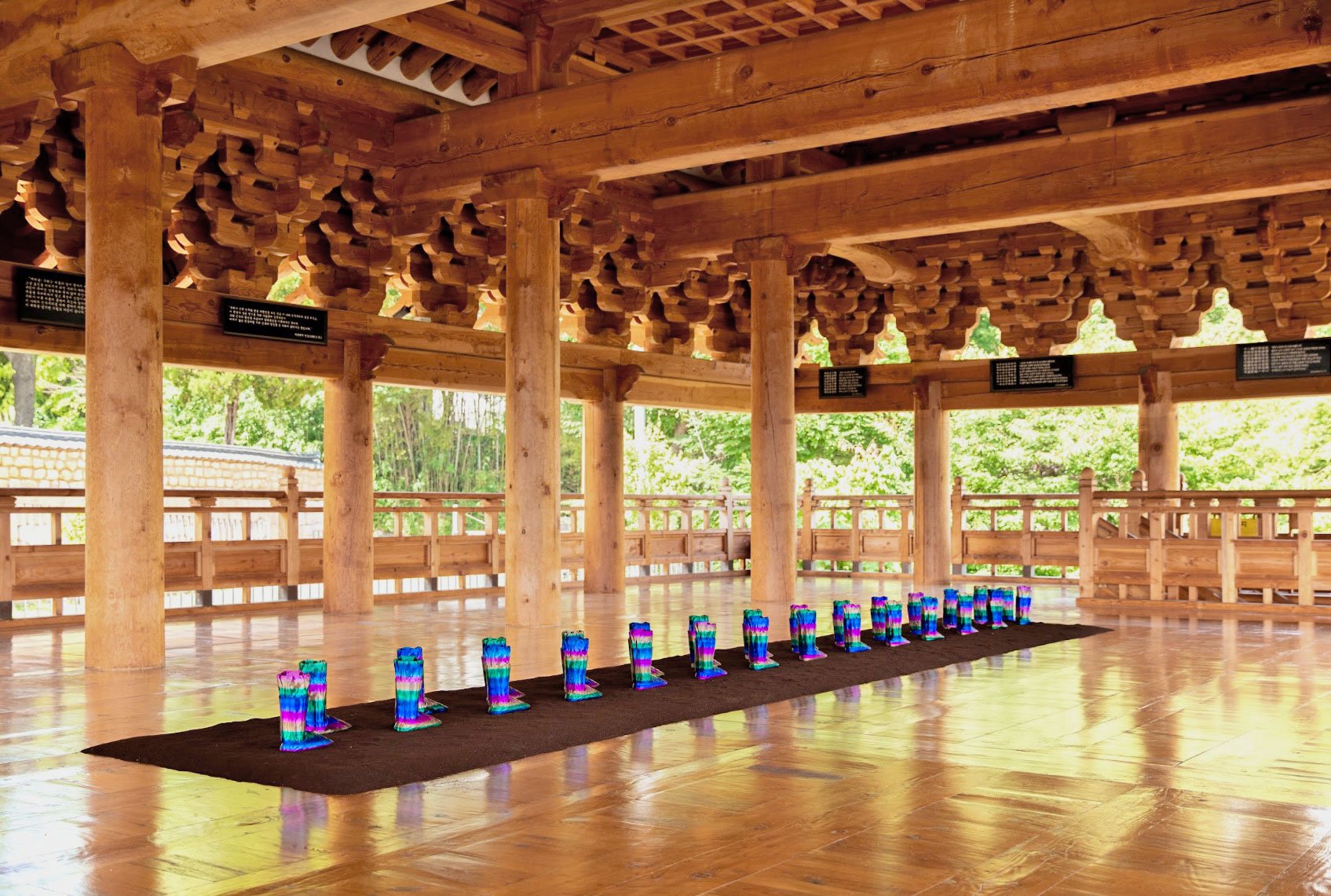
Jessie Kleemann: Kamiit Walking, 2026. Installation view. Kalaallit Illuutaat Pavilionen at the 16th Gwangju Biennale. Photo: Jaeseo Lee
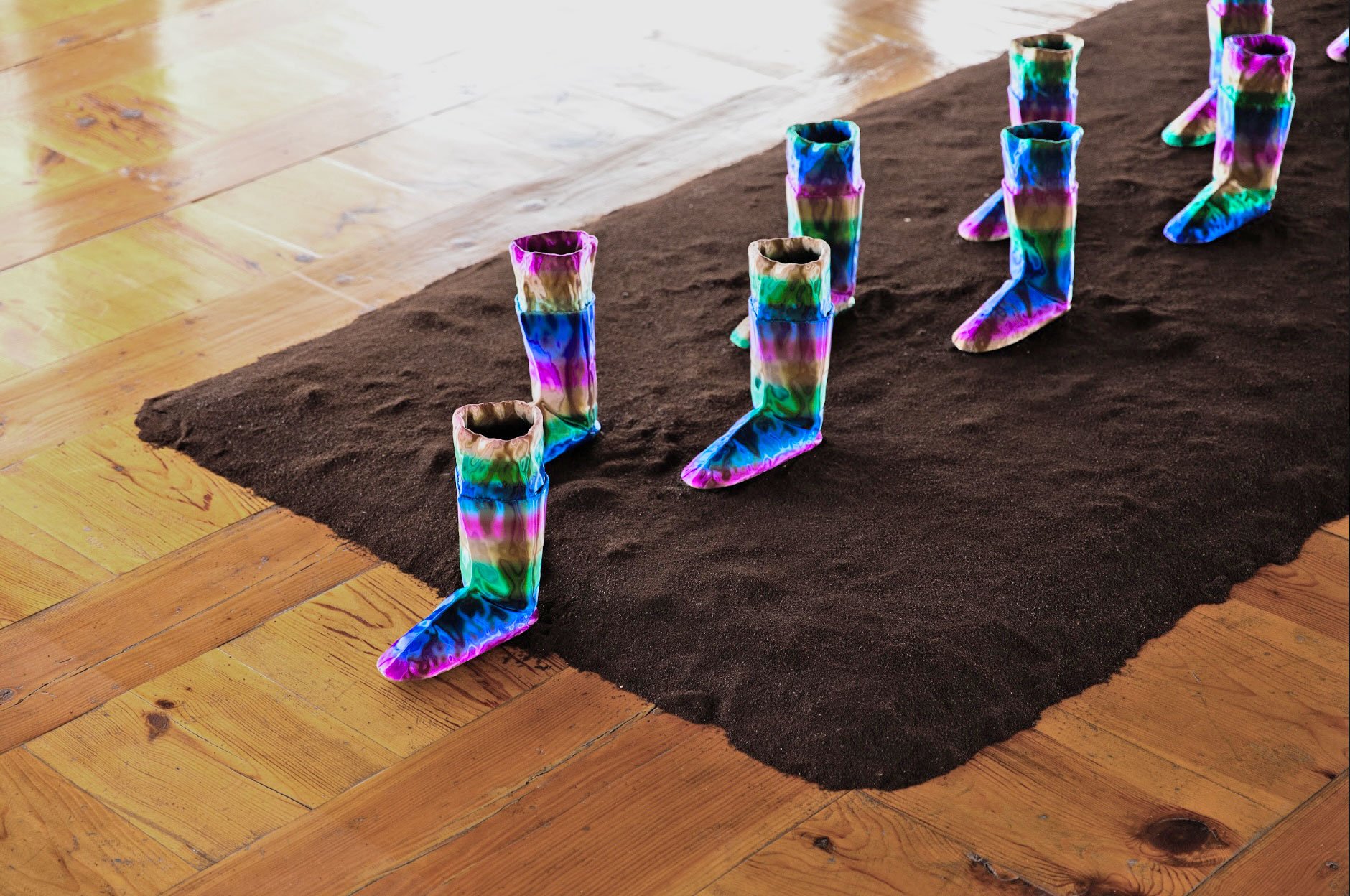
Jessie Kleemann: Kamiit Walking, 2026. Detail. Kalaallit Illuutaat Pavilionen at the 16th Gwangju Biennale. Photo: Jaeseo Lee
Resistance to dictatorial rule and the fight to shape our own futures is of utmost importance.
Jessie Kleemann
Part of the 16th Gwangju Biennale, You Must Change Your Life, the Kalaallit Illuutaat Pavilion’s Kamiit Walking presides in the Heekyungru Pavilion. Raised in 1454, Heekyungru was a meeting place for Joseon Dynasty scholars before it was demolished under Japanese colonial rule and rebuilt in 2023. Here, two colonial histories meet. The walk spans the 8,000 kilometers between Kalaallit Nunaat and the Korean Peninsula and enters into dialogue with Gwangju’s own histories of resistance.
“Now, as in the 1980 Gwangju Uprising led by the Democratic Movement, resistance to dictatorial rule and the fight to shape our own futures is of utmost importance,” says Kleemann.
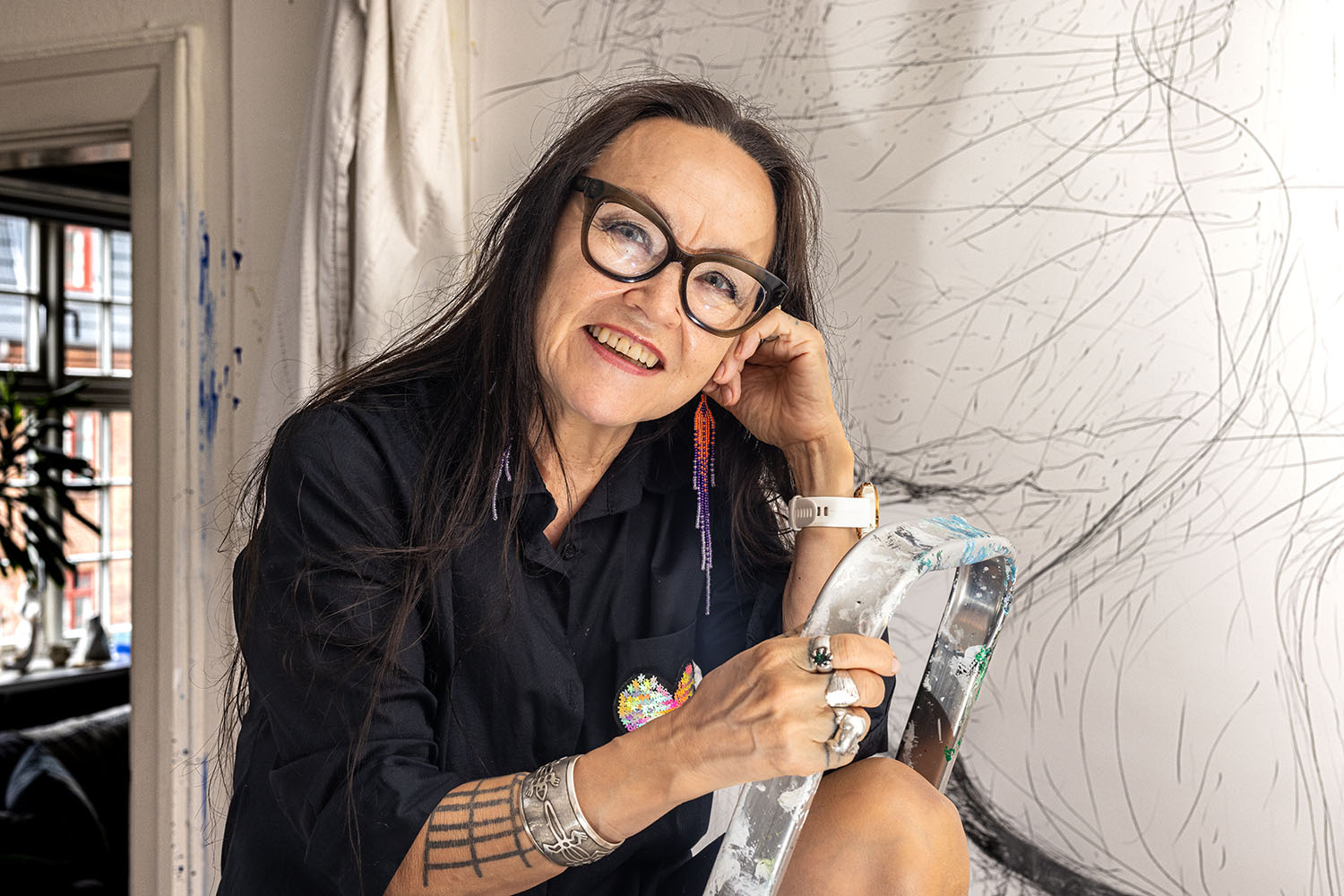
For four decades, Kleemann has explored land, identity, body, language, memory and sovereignty. Her own body is central to the work, alongside recurring materials such as coffee, beads and blubber. Her critique of colonialism extends to land, climate, community, and personal identity alike.
About
'Kamiit Walking' (2026) by Jessie Kleemann is on view at Heekyungru Pavilion as part of the 16th Gwangju Biennale, 'You Must Change Your Life', until 15 November 2026. The Kalaallit Illuutaat Pavilion is curated by Danish curator Louise Bjeldbak Henriksen and American curator Amy E. Smith for Kalaallit Illuutaat | Det Grønlandske Hus.
We are so many women who walk together. We become one body walking.
Jessie Kleemann
One body walking
The kamiit in Kamiit Walking are women’s kamiit–not men’s. They pay homage to the women who have carried knowledge between traditional and contemporary ways of life and who so often set the pace and lead communities toward social change.
“We are so many women who have walked in the same kamiit. We are so many women who walk together. We become one body walking.”
In Kalaallisut, “kamiit walking” stresses the act of taking steps, where “walking kamiit” would suggest a passive drift: these boots move with purpose, they move toward something. Kamiit is plural (a single boot is a kamik) so the title carries the fact of company within it. Kleemann names some of the women on whose strong shoulders she stands: her grandmother, her mother, the aunt who raised her, and trailblazing women such as Gudrun Chemnitz and Priscilla Josefsen. The installation has a strong bodily presence, as though the boots are borne forward by unseen figures, spirits perhaps.
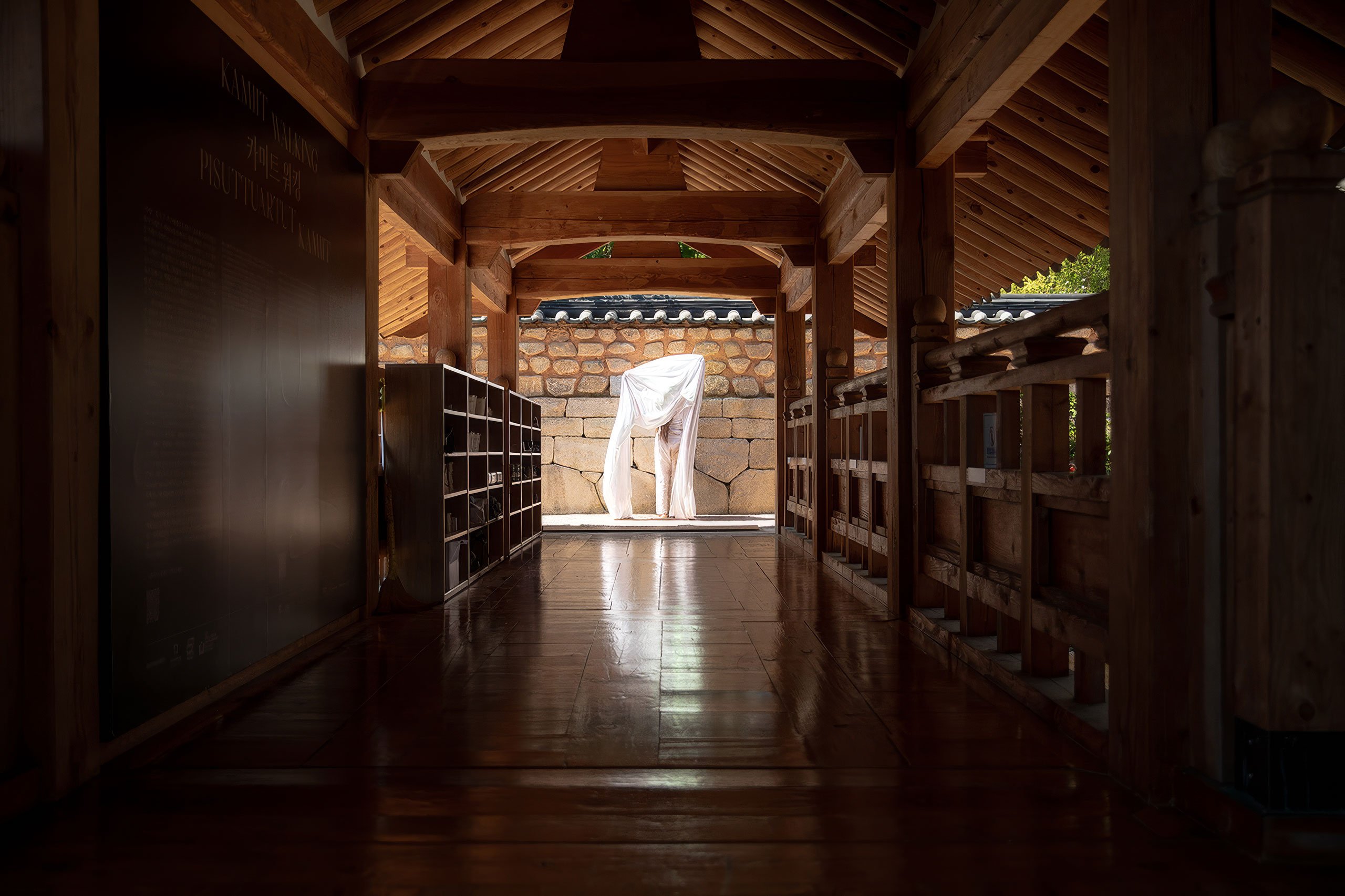
Jessie Kleemann: Kamiit Walking, 2026. Performance. Kalaallit Illuutaat Pavilionen at the 16th Gwangju Biennale. Photo: Jaeseo Lee
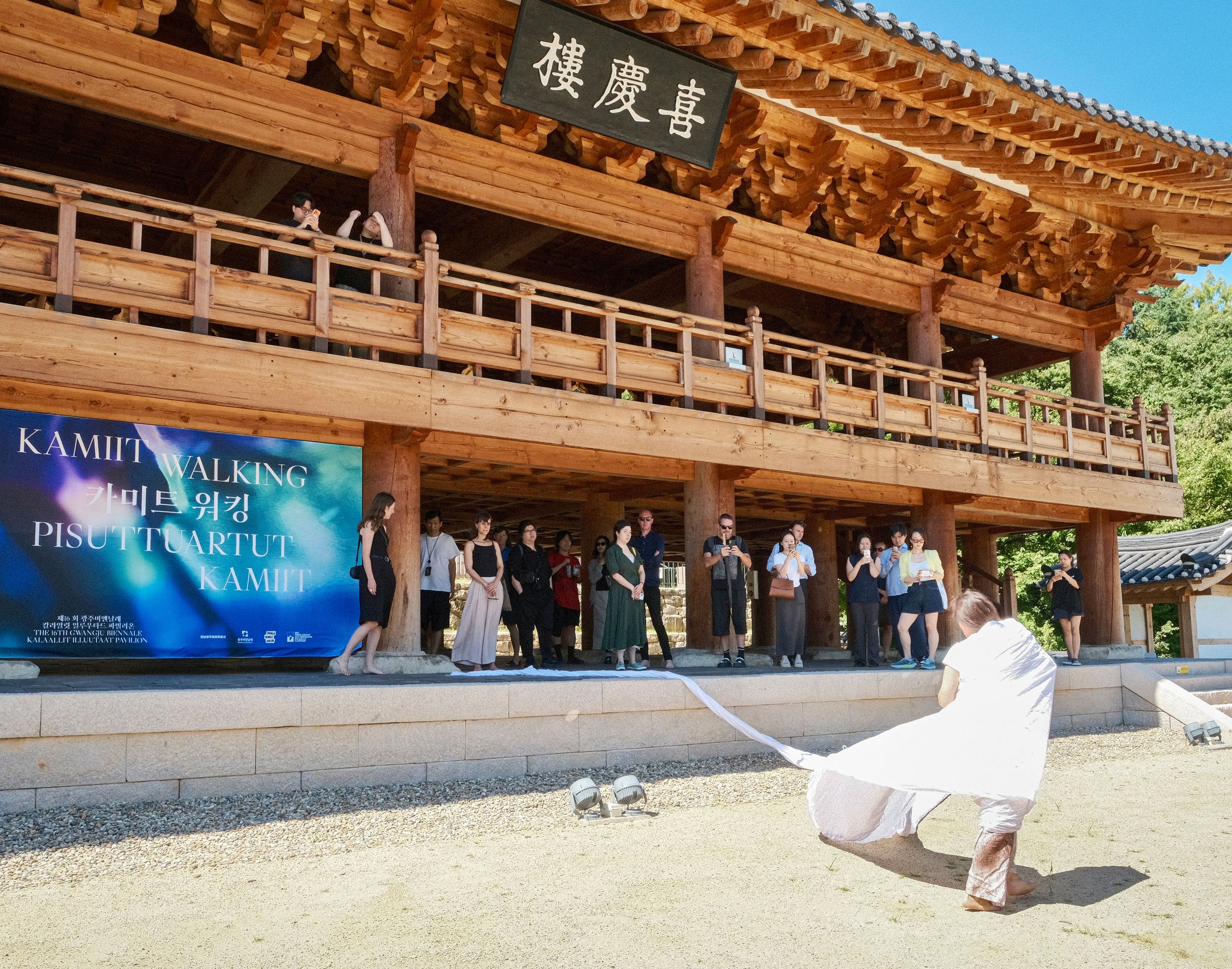
Jessie Kleemann: Kamiit Walking, 2026. Performance. Kalaallit Illuutaat Pavilionen at the 16th Gwangju Biennale. Photo: Jaeseo Lee
Like many of her generation, Kleemann trained in other fields, and others carried the craft of sewing kamiit. The scan gives the worn originals a second life, light enough to travel halfway around the world. For Kleemann, tradition is a living tool, as available as any physical material. Pairing an inherited form with new technology unsettles the notion of “ancient Indigenous wisdom,” which consigns Indigenous cultures to the past.
A path of coffee
Coffee is itself a colonial commodity, carried along the trade routes that built European fortunes. It has also become the warm center of kaffemik, the gathering where family and neighbors draw close around the table.
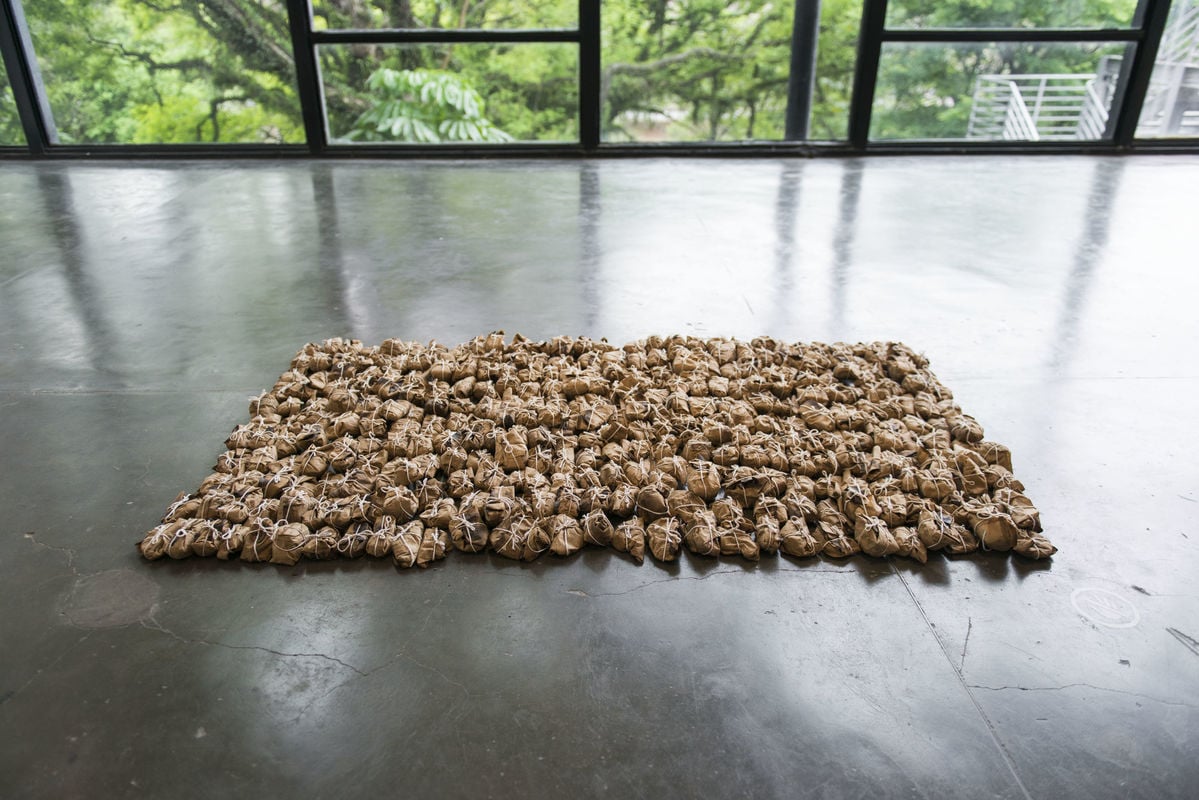
Pia Arke: Jord til Scoresbysund (Soil for Scoresbysund), 1998. 34th Bienal de São Paulo, 2019-2020. Photo: Levin Fanan
The path also honors Pia Arke’s Soil for Scoresbysund (1998/2024), 151 used coffee filters dedicated to the Kalaallit forcibly relocated by the Danish state in 1924, many of whom died in famine. The filters recall the practice of fertilizing the thin soil with spent coffee grounds. The scent of coffee fills the pavilion, and on breezier days it even reaches visitors before they lay eyes on the work.
Soil is precious in Kalaallit Nunaat, sealed beneath permafrost and stone. As the climate shifts, it has begun to move, and the land stirs and turns. It is alive, needs nutrition and care, and it also sleeps. For Kleemann, the land–just like other living beings–has a body too, and she feels its restlessness as kinship. Laying a strip of dark ground across a wooden floor in Korea brings that unsettled land into the room.
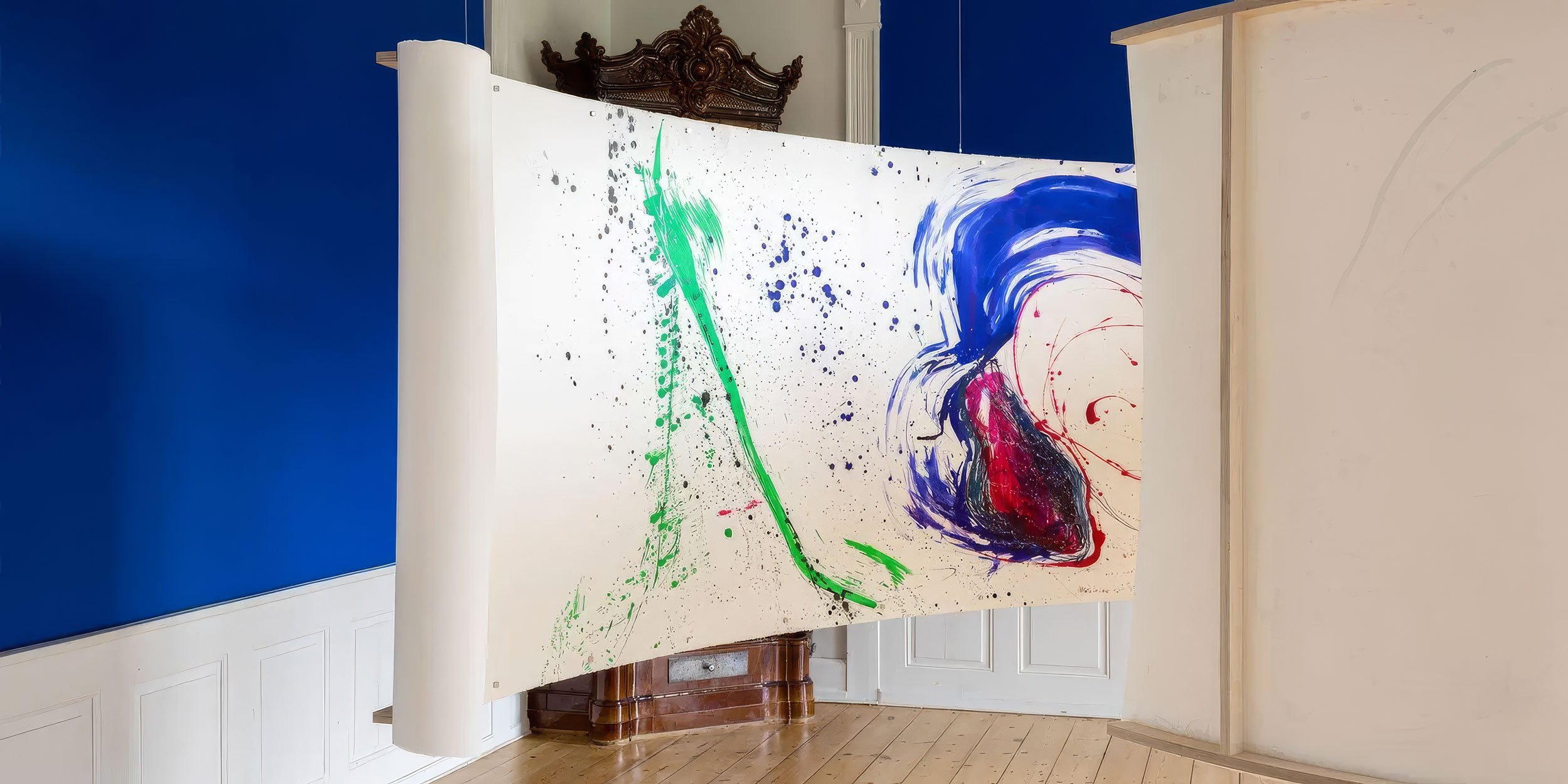
From the exhibition at Rønnebæksholm: Jessie Kleemann: Lá. Læ. Likkja. Magna, de små organismer puster og pruster til SASSUMA., 2023 (detail), Photo: Malle Madsen
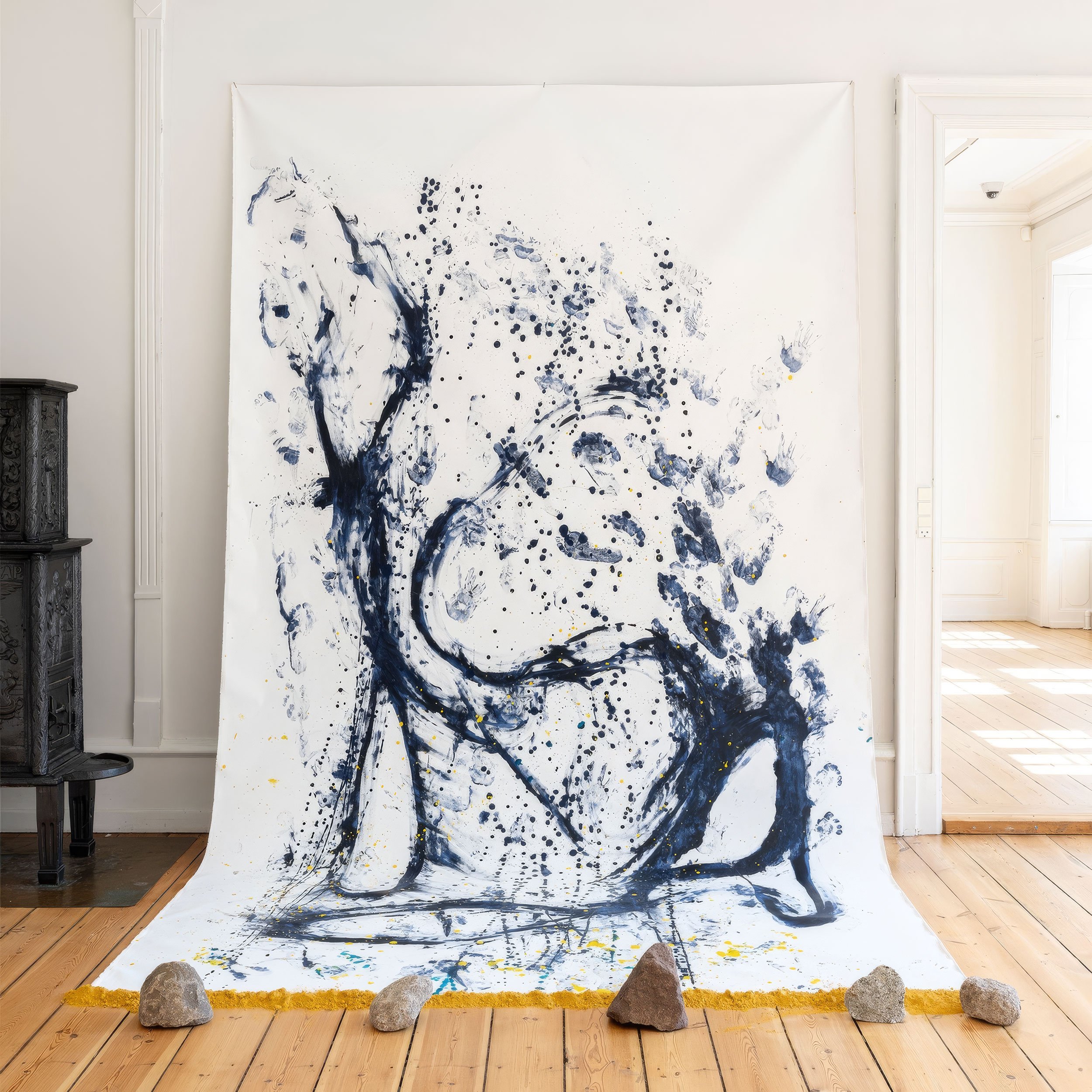
From the exhibition at Rønnebæksholm: Jessie Kleemann: Lá. Læ. Likkja. Magna, de små organismer puster og pruster til SASSUMA., 2023 (detail), Photo: Malle Madsen
The colors trace back to a wonder from Kleemann’s childhood: bluebells rising, as if by miracle, from minuscule cracks in the scree beneath the midnight sun. She has photographed the Arctic and its marvels ever since the days of roll film. The kamiit’s gradients recall those bluebells and the northern lights, with violets, greens and golds now shining in the boots. Where the original kamiit carries black-and-white designs, Kleemann’s gradients gesture hopefully toward open, self-determined futures, and their smooth transitions present fluidity as a survival tactic in its own right. Those relocated to Scoresbysund had no choice but to work the land they were forced to inhabit. The last kamik, by contrast, chooses its own way, stepping off the path and onto uncharted territory while still carrying the shape of what came before. Change unfolds over lifetimes, each step tilting slightly until a new course emerges from the old.
Crossing the river
The boots seem to walk on their own, carried by unseen bearers. At the pavilion opening, one of their bearers stepped into view. Rising from a bed of coffee as if reborn, Kleemann moved through Heekyungru with a long, fine, translucent white fabric. White on white, its iridescent surface shifted from sunshine to rose to blue, like light moving over the polar ice of Kalaallit Nunaat. At times the fabric moved like the sea–rocking, breathing, heaving, swelling, rolling, breaking and gathering.
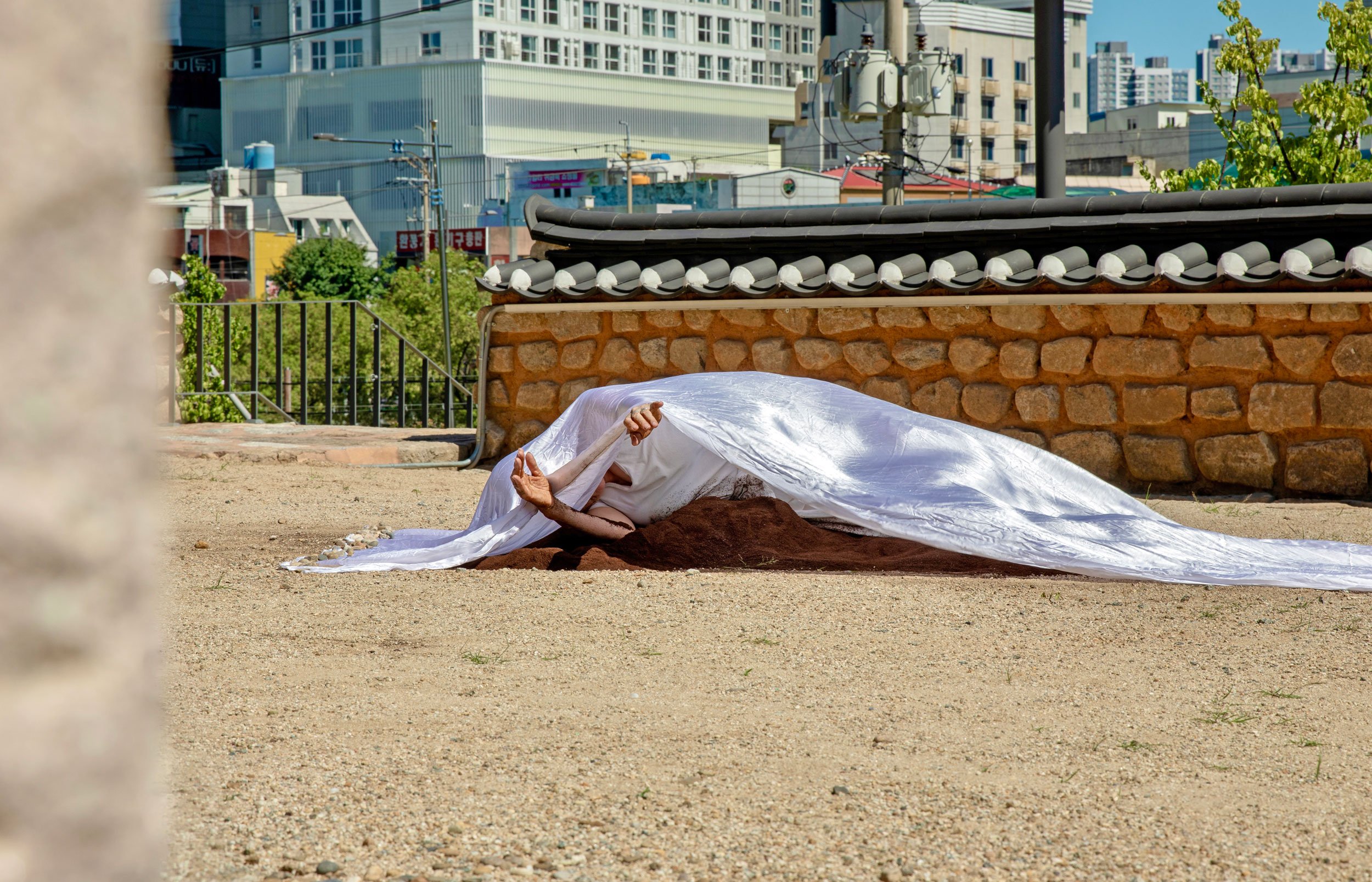
Jessie Kleemann: Kamiit Walking, 2026. Performance. Kalaallit Illuutaat Pavilionen at the 16th Gwangju Biennale. Photo: Jaeseo Lee
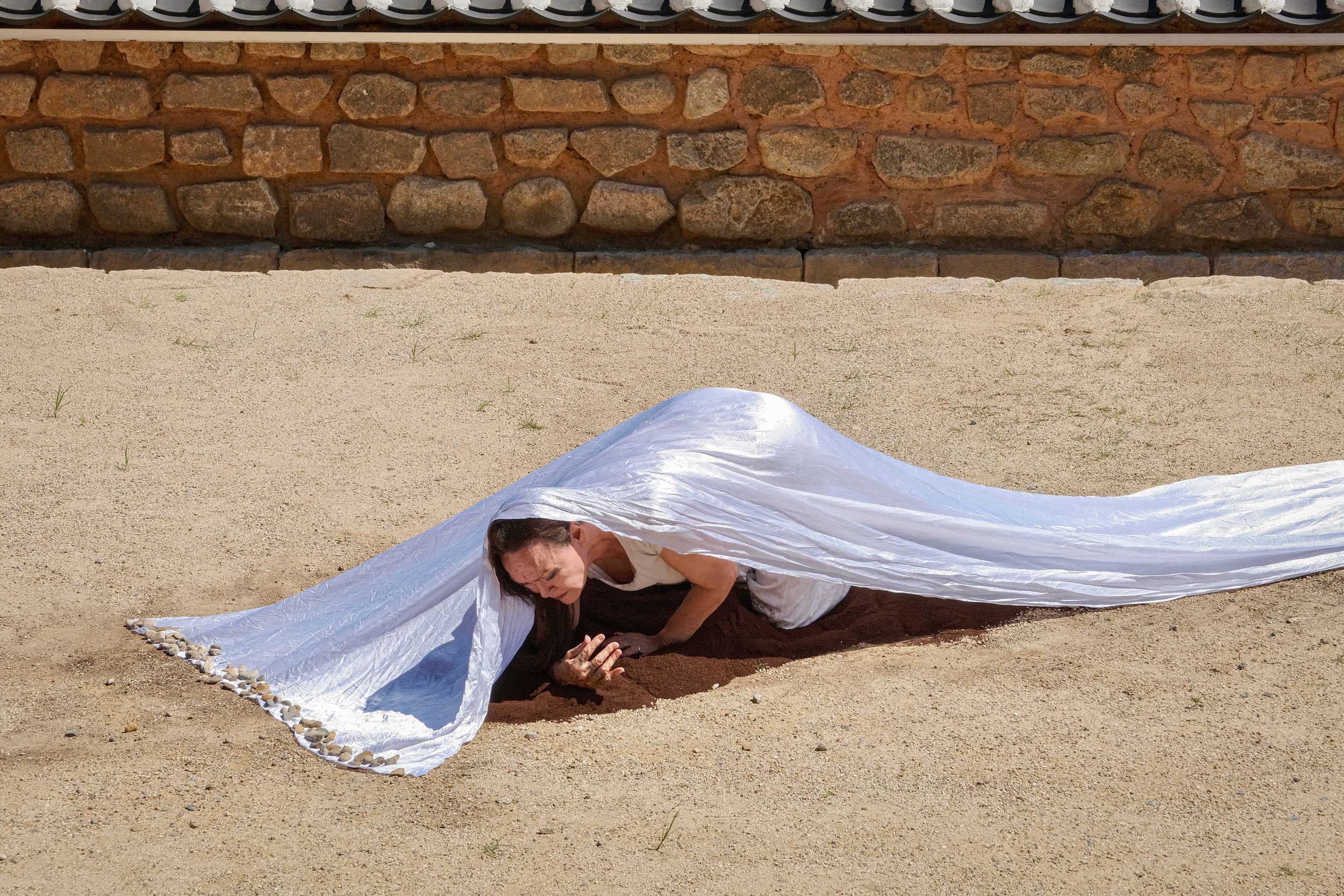
Jessie Kleemann: Kamiit Walking, 2026. Performance. Kalaallit Illuutaat Pavilionen at the 16th Gwangju Biennale. Photo: Jaeseo Lee
Now living in Denmark, Kleemann uses such associations to bring that landscape closer. Fabric has accompanied her since her years in Nuuk: a black cloth for more than thirty years, white tulle for more than twenty. It weighs almost nothing, fits in a suitcase, and can become a presence or a room within the room.
In Gwangju the fabric became a river. The image comes partly from the book Sjæl gør dig smuk [Soul Beautify Thyself], gathering old sayings, Knud Rasmussen’s collections and other artists’ texts on where we are and where we are heading.
“When you cross the river, it actually means something. It means you have gone over to the other side.”
Now I am right here, in one culture and in the other.
Jessie Kleemann
White carries its own history. The men’s white festive anorak took hold when the colony’s dark fabric became too costly, while women’s dress is richly colored and coded to mark the stages of a life, conventions that likewise arrived with colonization.
Wearing white can be a way to wash it all clean, she says: “Now I am right here, in one culture and in the other.”
Jessie Kleemann: Kamiit Walking, 2026. Detail. Kalaallit Illuutaat Pavilionen at the 16th Gwangju Biennale. Photo: Jaeseo Lee
The white sets itself against the colorful traditional Greenlandic women’s dress, whose colors chart a woman’s life from birth through marriage to widowhood, and whose codes arrived with colonization. The crossing can also be a beginning: “I could just as well have started in the womb, and then grown into new life again.” Only later, watching drone footage, did Kleemann notice a river running near Heekyungru. “Wherever we are in the world,” she says, “there is a river.”
Again, and again
Repetition runs through her practice at every scale. The same materials return across decades: coffee, beads, blubber, the black cloth and the white tulle. Gestures recur from one performance to the next, and works are taken up again in new iterations and new places, each time carrying traces of the last. Kamiit Walking is a sister piece to Kamiit (2023), also constructed of coffee grounds and 3d-printed kamiit and first presented in Kleemann’s 2023 SMK retrospective Running Time.
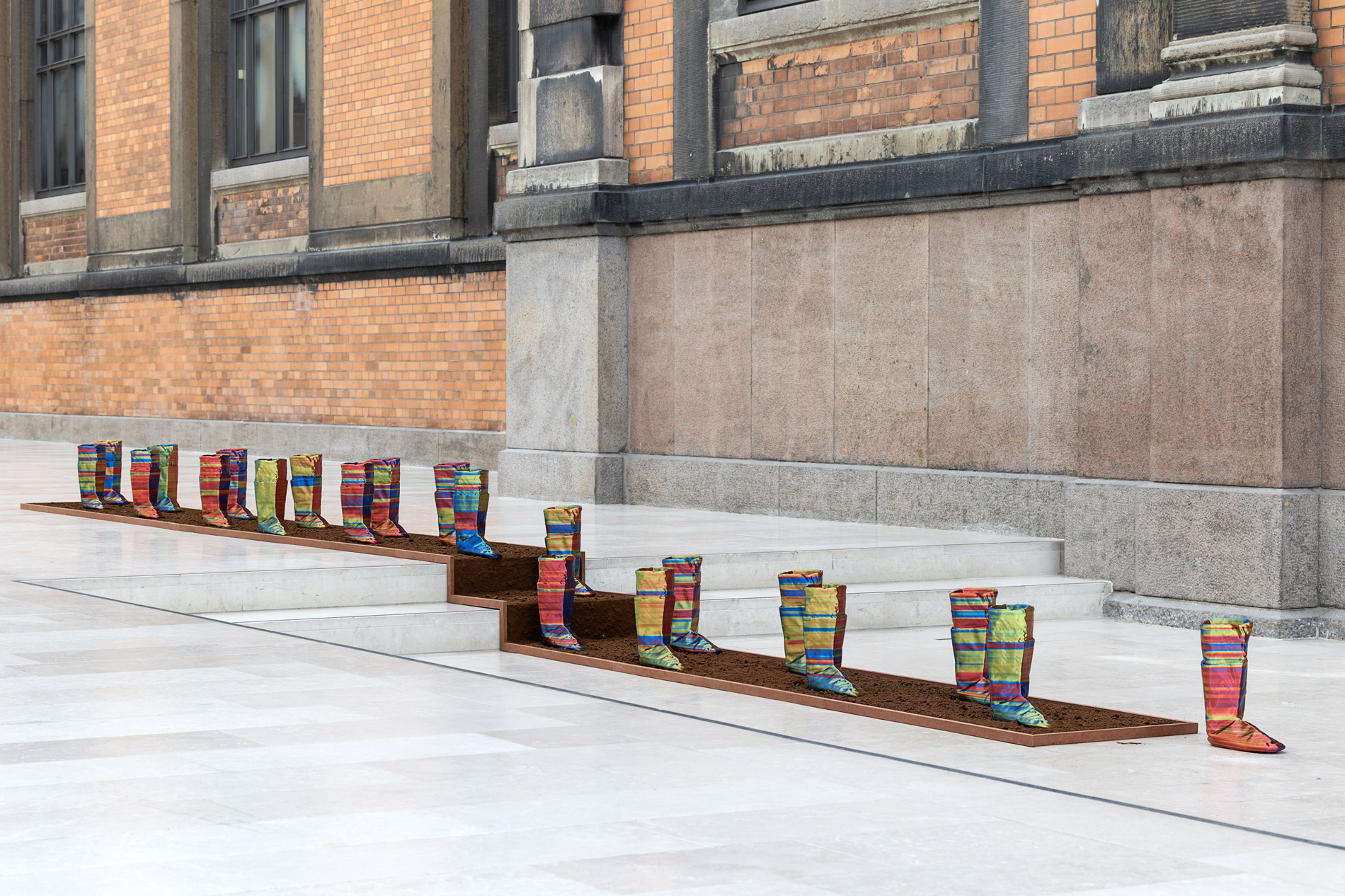
Jessie Kleemann, Kamiit (detalje), 2023, Courtesy Jessie Kleemann. Photo: Frida Gregersen
In this new imagining, Kleemann responds to the increased urgency of the climate emergency. She draws colors from the earth and sky and frees coffee from a wooden frame to bring the piece closer to nature. In Kamiit and Kamiit Walking, a single inherited boot multiplies into a procession. Like a ritual, each return adds a layer of meaning, and each step holds the steps that came before it.
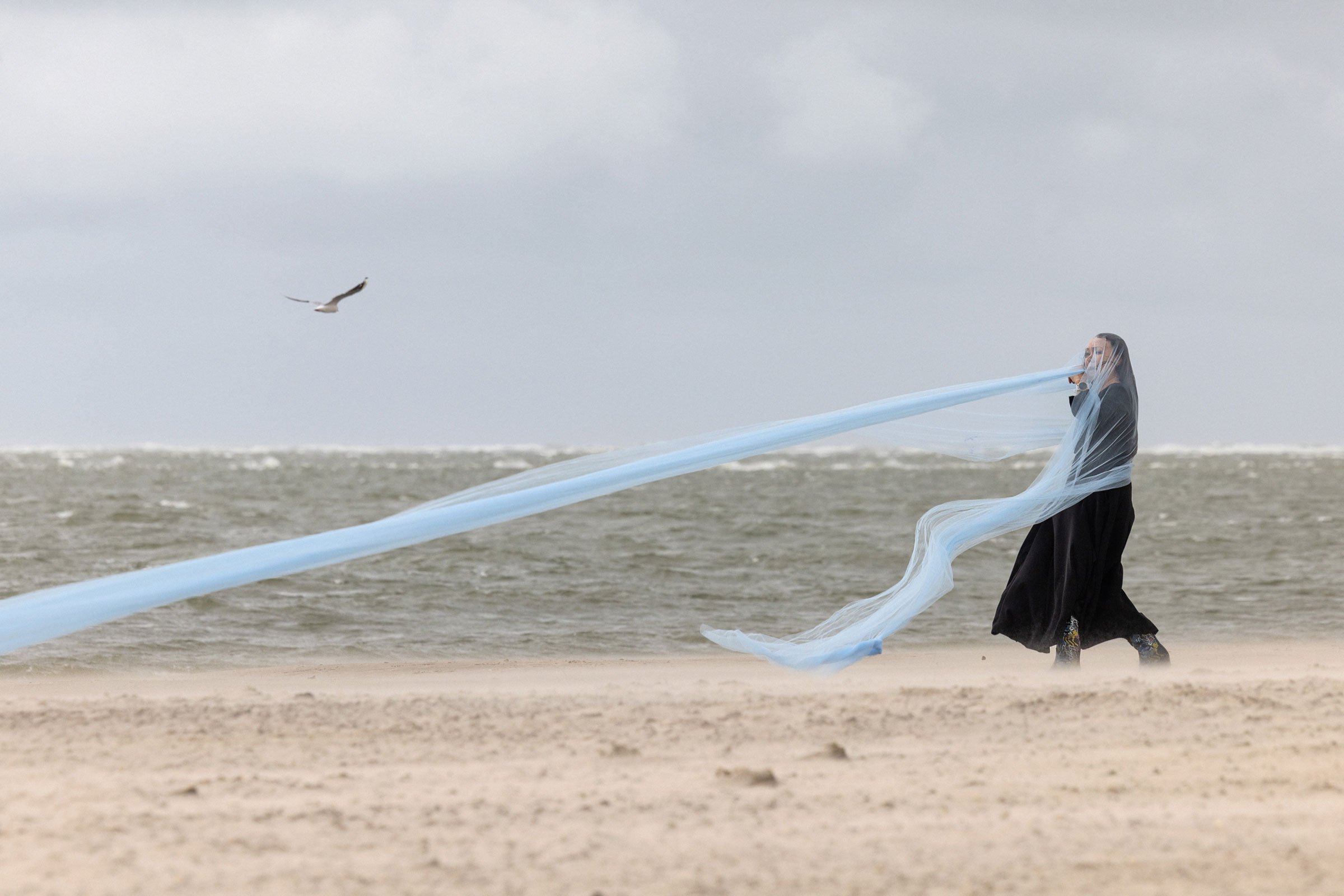
Jessie Kleemann: Spirit of The Flying Kayak. Wadden Tide 2026. Photo: Frida Gregersen
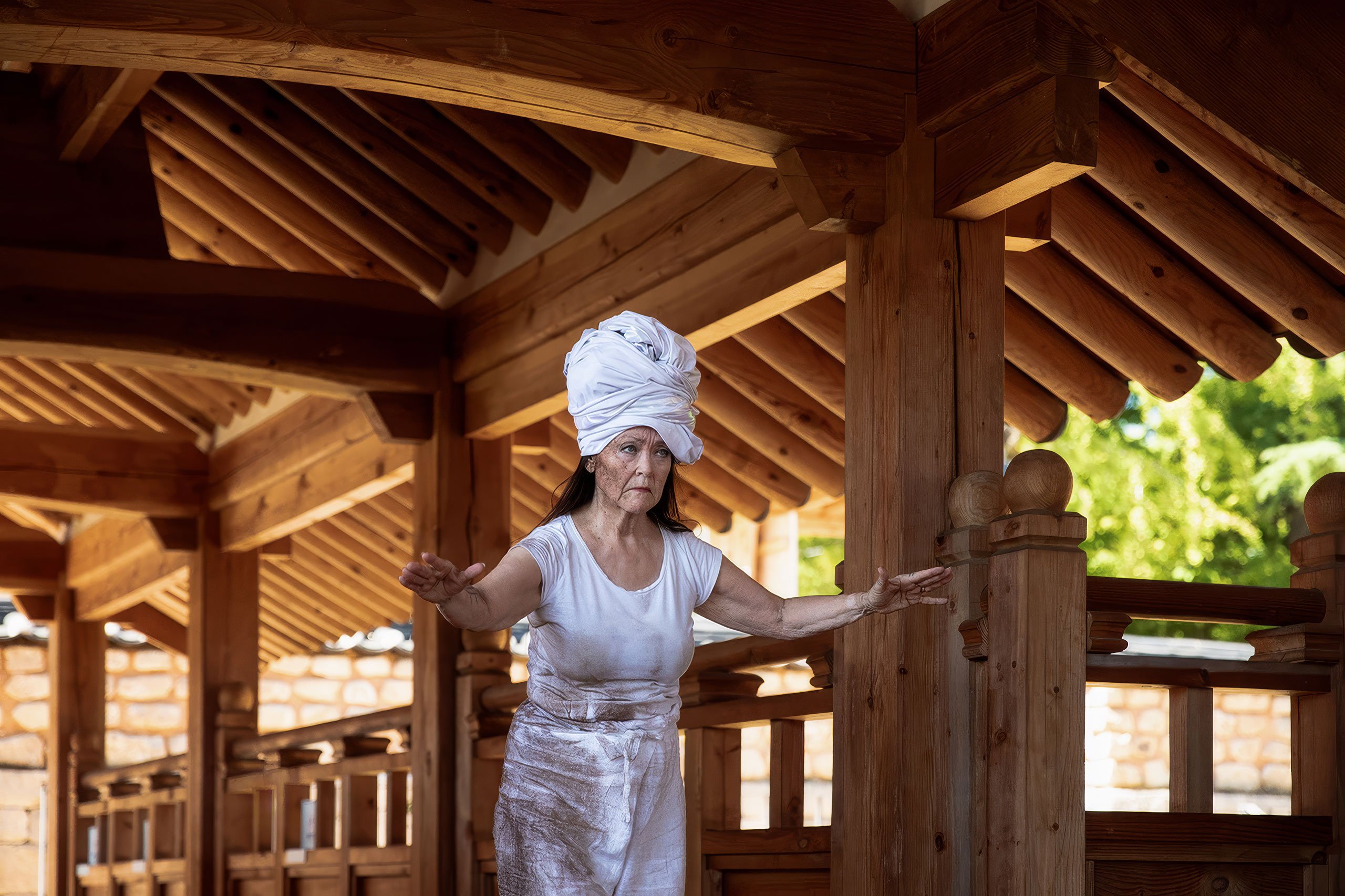
Jessie Kleemann: Kamiit Walking, 2026. Performance. Kalaallit Illuutaat Pavilionen at the 16th Gwangju Biennale. Photo: Jaeseo Lee
Kleemann’s performances often have the quality of ritual. She enters a state of deep absorption, and afterwards she often has little memory of what took place. Her body seems to hold what her mind lets go, and the camera keeps a record she herself may never fully recall. Her movements are intuitive: “Sometimes I leave it up to the room. I let myself fall into it. And then I know my body naturally does what it has to do. Then it is my arms or my hands, my legs: where do they lead me?”
They might well lead her into a new world.