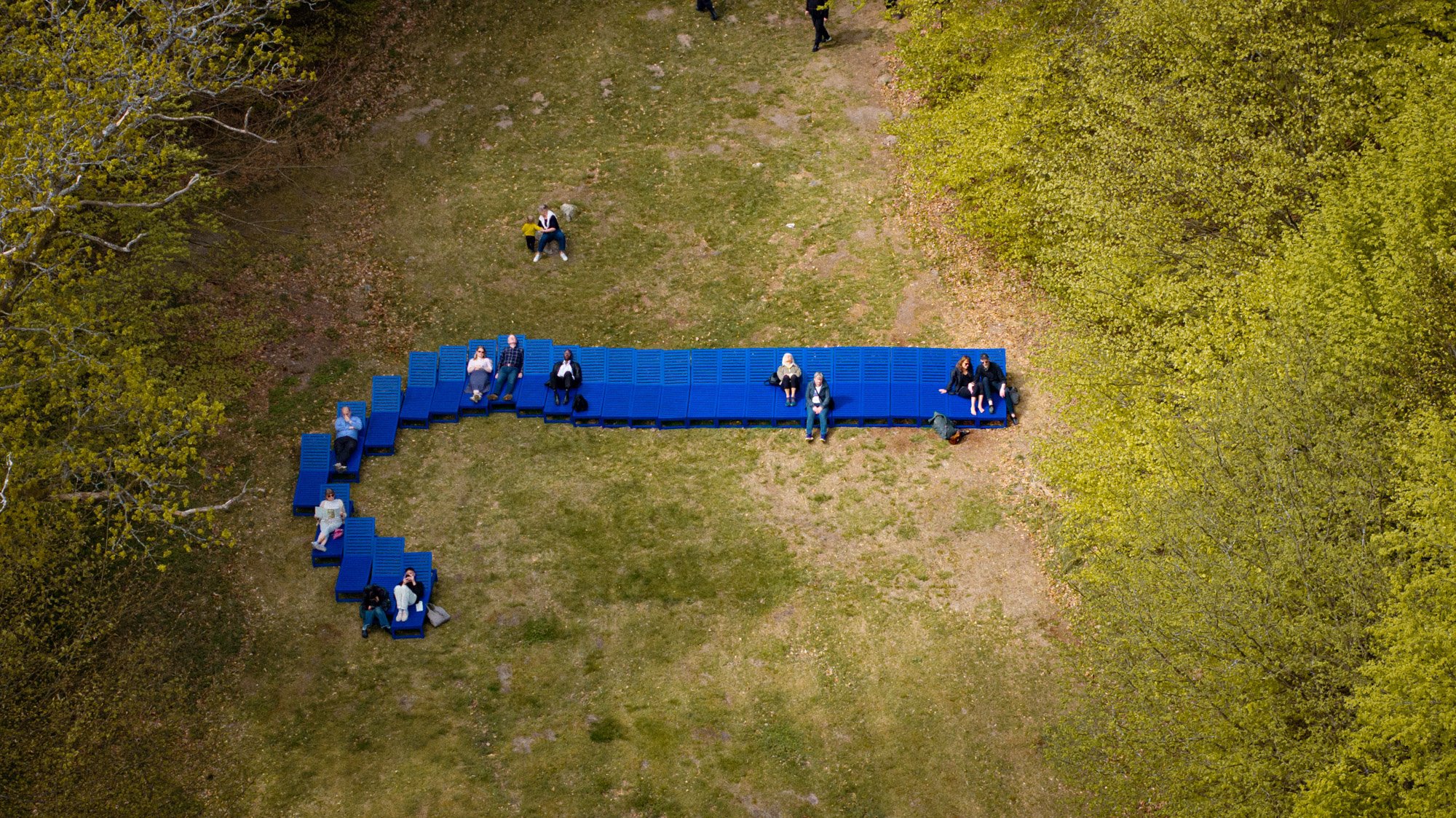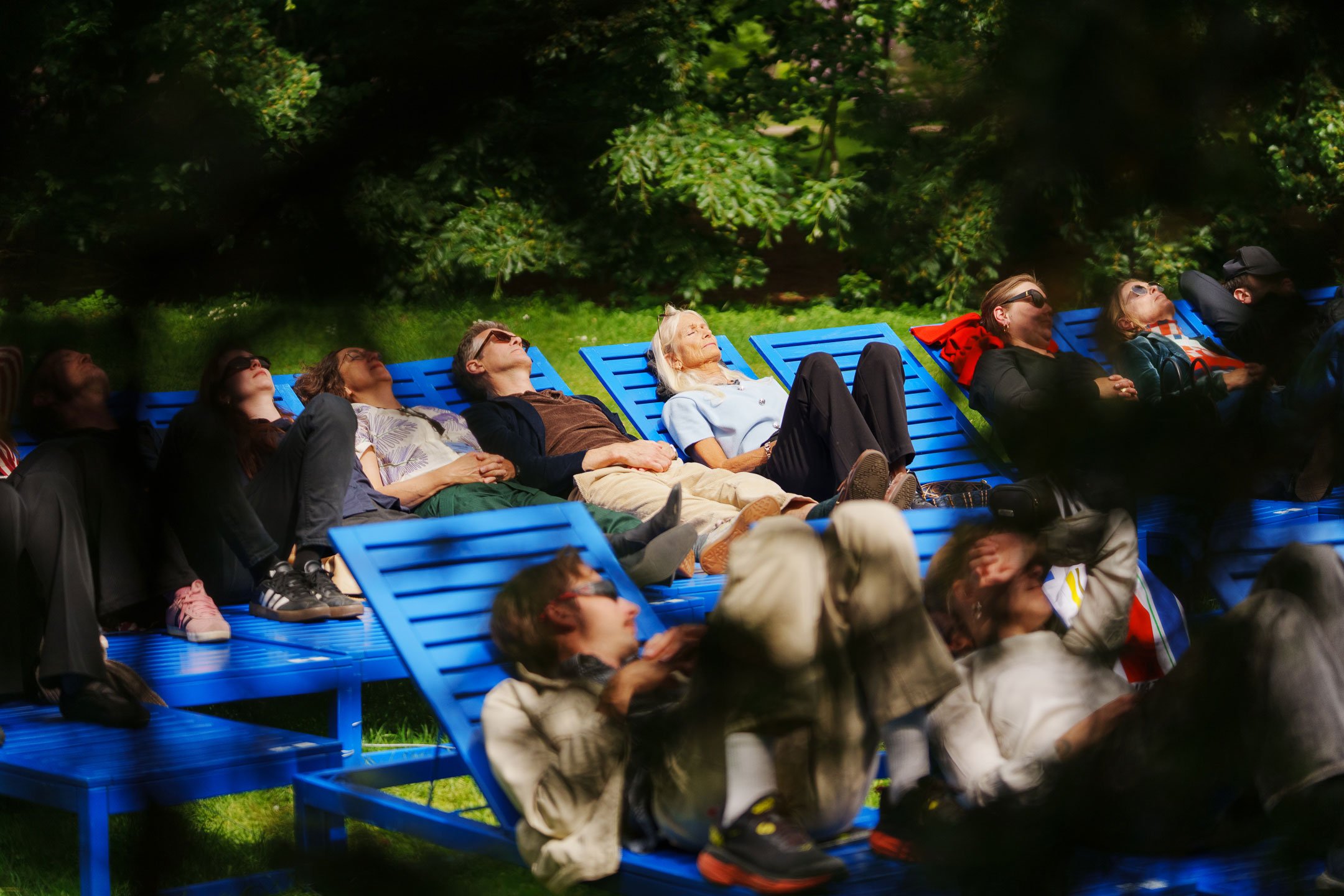
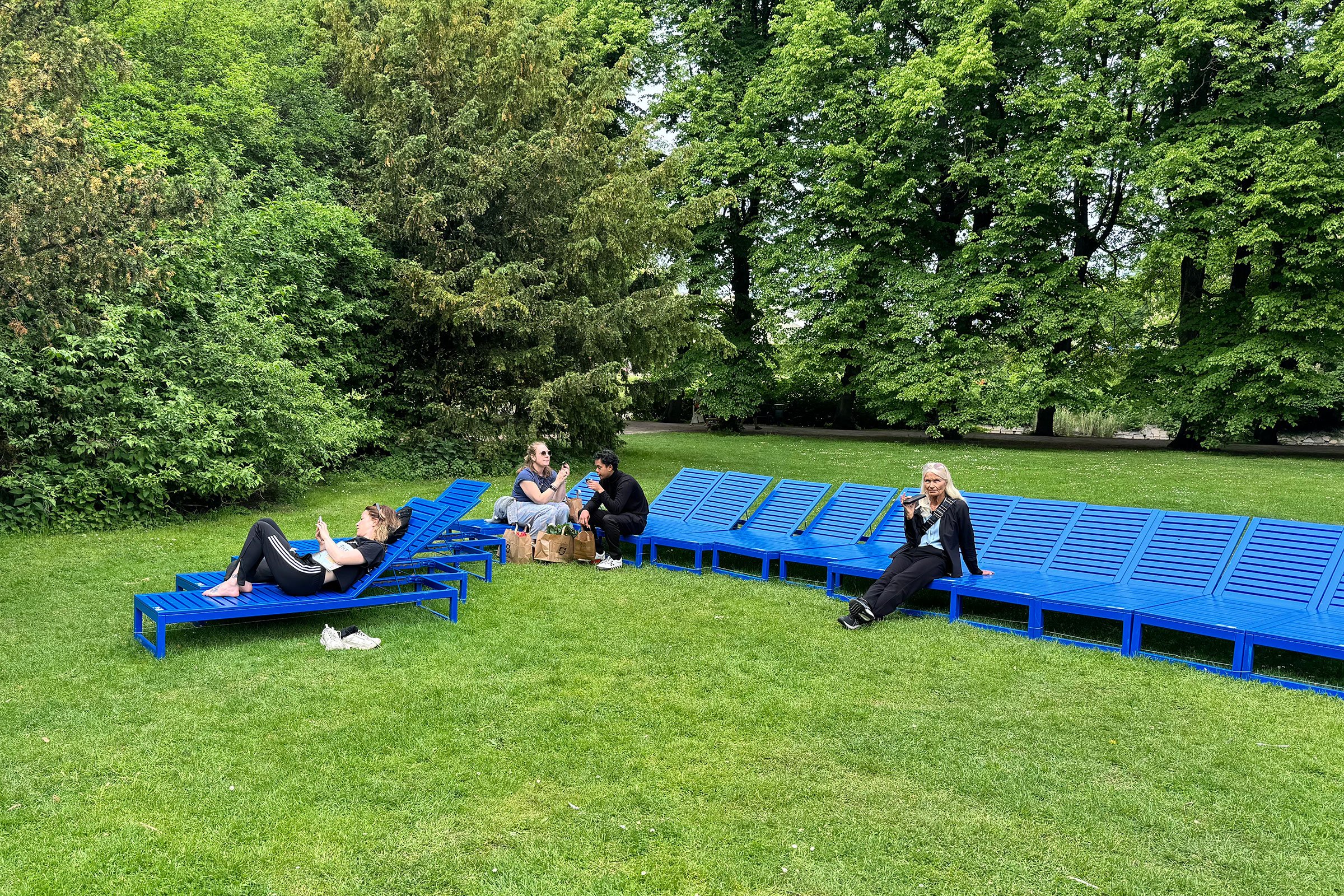
During Art Matter Festival 2026, Malmö Konstmuseum inaugurated a new acquisition, This Feeling, Oceanic, by the New York–based Lebanese artist Youmna Chlala. The work is a sound installation with a physical seating structure placed in a park next to the museum’s temporary venue in Kungsparken in Malmö. This building is a projected location for a future Malmö Konstmuseum.
On this occasion, we made an online interview with the artist in New York. Youmna Chlala is both a visual artist and a poet with a strong sense of material, body and language. In her work the tangible and intangible are closely connected, and even if her work is deeply personal and rooted in real-life events, they are poetic and open for the visitor to experience and unpack.
This Feeling, Oceanic is part of an ongoing series of work Museum of Future Memories. What were you impulse and thoughts when you started this project? And what has it brought about?
“The project began when the curator Milena Høgsberg (former director and chief curator of Wanås Konst, ed.) and I spoke about images connoted by the ocean in the forest. When I walk in a forest, I have always felt as if I was at the bottom of the sea floor and that the plants, trees and flowers had stayed long after the water evaporated. I had also recently been an artist in residence at IASPIS in Stockholm where I researched labyrinths that resembled each other on the southern shores of Sweden and the Mediterranean. The labyrinthic forms, demarcated through drawing in landscape and activated by human movement, had the ability to affect change. This Feeling, Oceanic brings these ideas together through form, concept and personal narrative.”
What happens when the horizon line disappears. How do we know where we are?
Youmna Chlala
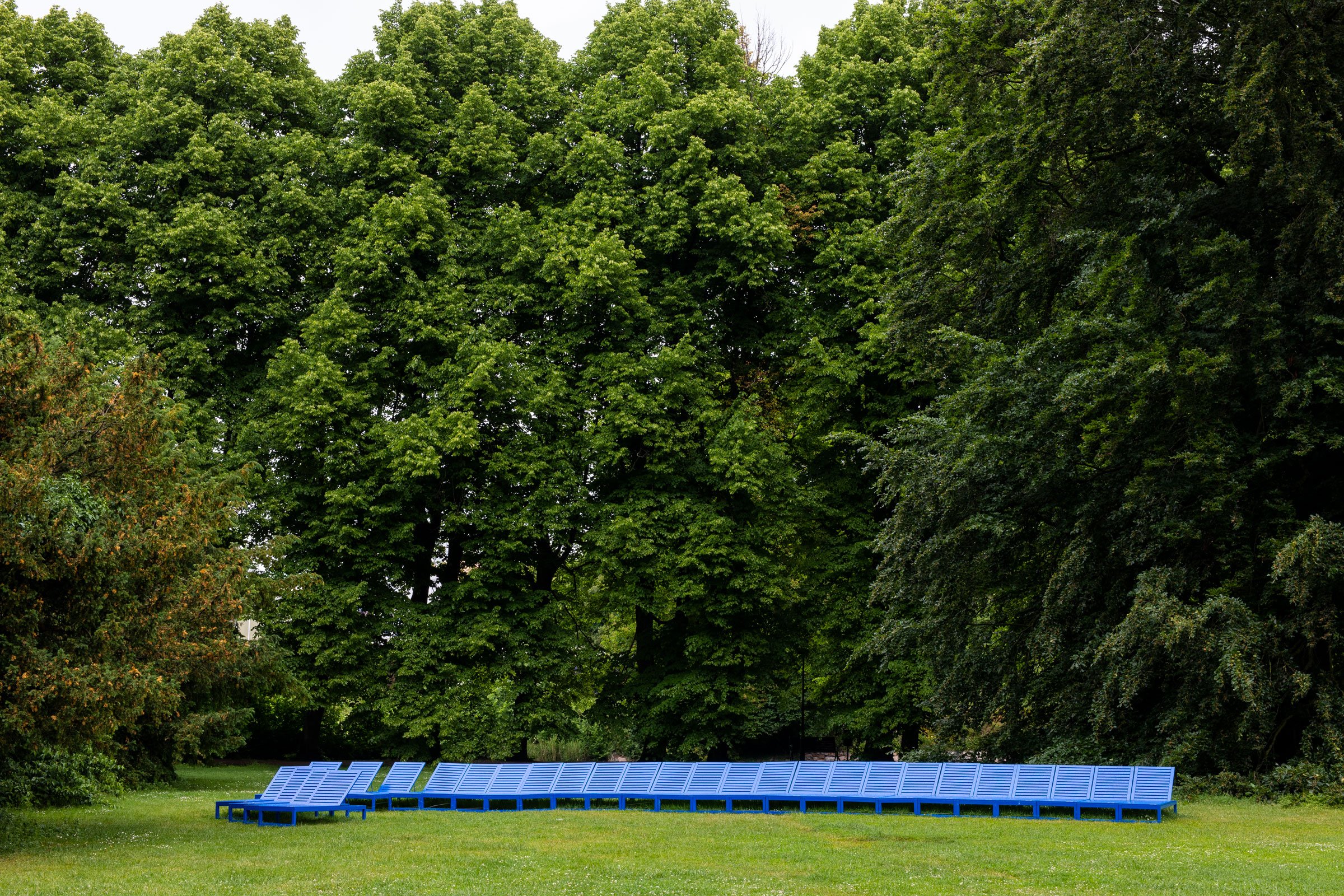
Youmna Chlala: This feeling, Oceanic, 2024. Photo: Helene Toresdotter/Malmö Konstmuseum
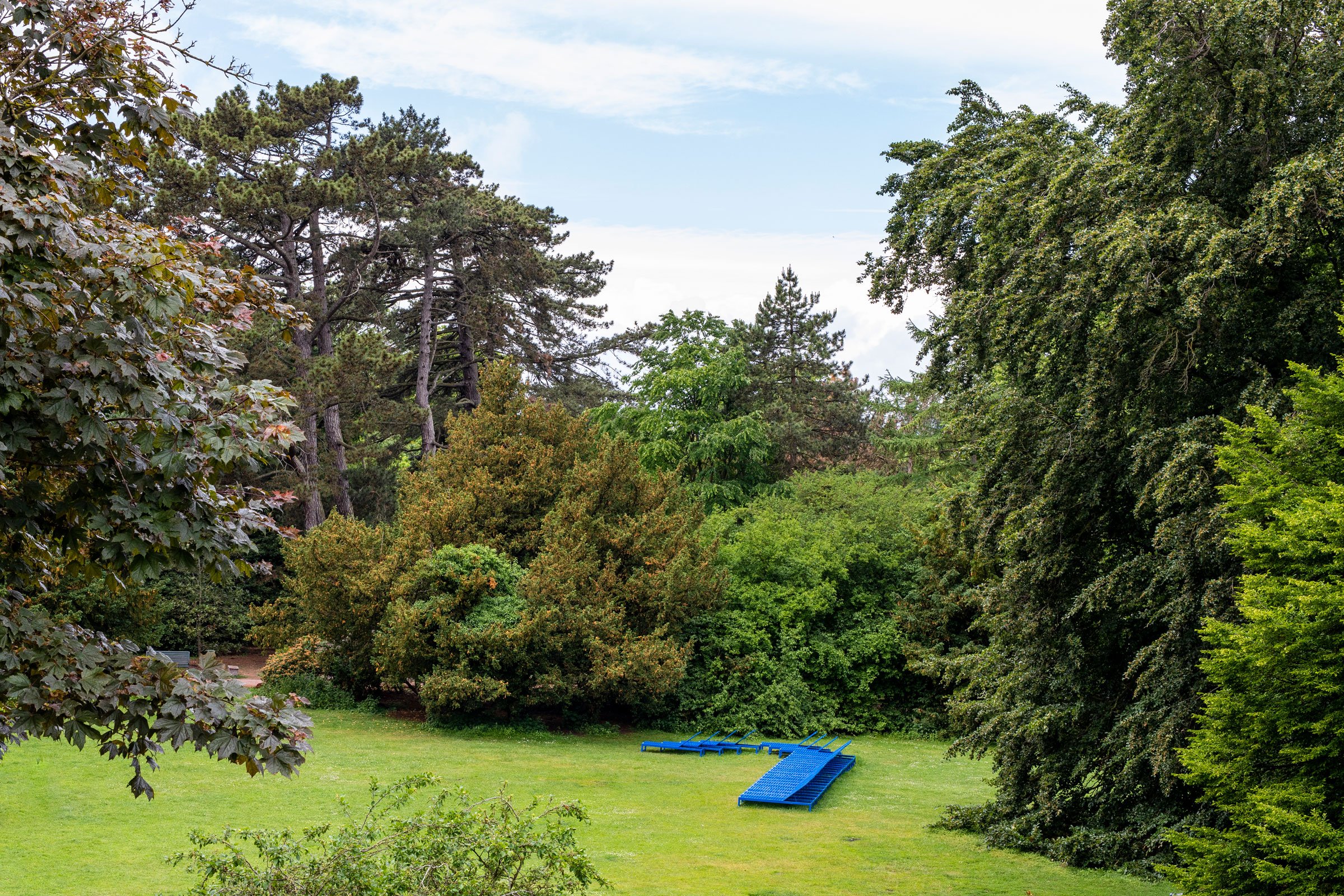
Youmna Chlala: This feeling, Oceanic, 2024. Photo: Helene Toresdotter/Malmö Konstmuseum
The narrative in the work employs some strong images or metaphors such as the horizon and the ocean. Would you elaborate on their meaning both on a general or poetic and a personal level?
“For the last few years, through the conceptual frame of The Museum of Future Memories, I have been making work based on the question of what happens when the horizon line disappears. How do we know where we are? This originated from a speculative artwork and a short-story that I wrote in Norway about a future city where the sea and sky are no longer separate. The project grew into multiple site-specific iterations. The questions expanded into how we locate ourselves when the point of reference is unstable. What shifts internally, physically and collectively if the horizon line is an apparition (alluding to both past and future time) rather than a solid line that bifurcates sea and sky? My personal interrogation is also about how I encounter the line as an artist. I have long been obsessed with the modernist line as it appears spatially and architecturally.”
The title hints to The Oceanic Feeling a psychoanalytical term that refers to the time when the infant is indistinguishable from the mother. But in your piece, the oceanic feeling expands to a limitless bond to the external world. In what ways does the sea function as a space where the boundaries between self and other dissolve?
“I was initially thinking about how the sea is a body of water that holds memory. When I learned about the psychoanalytical reasoning of the ocean feeling, I was struck by the idea that the limitless bond between mother and child is both encompassing and temporary. This feeling that is so physical is also time-based. If memory is suspended time, how can it exist in a space like the sea that is always in motion? The only way to access the memories is to dissolve the boundaries between body and space.”
Youmna Chlala: This feeling, Oceanic, 2024. Photo: Jan Falk Borup/Art Matter
The near and the distant play roles on different levels in the work. You are based in New York, the visitor is in Malmö in this case, and the soundtrack brings you for example to the 2006 Lebanon War, an art school in California and to migrants drowning in the Mediterranean. On the other hand, you have decided to place the deck chairs close to each other, so the listeners literally sit very close to each other. What are your thoughts on this distance and physical proximity?
So much of my understanding of the world is based on adjacencies.
Youmna Chlala
“So much of my understanding of the world is based on adjacencies. I learn through intimate encounters, so I create them through my art works. The beach chairs are a marker of a relaxed body and although painted cobalt blue, they connote the warm orange and yellow tones of sun and sand. As objects, they represent how being near the sea encourages specific behaviours from play to contemplation. As a spatial drawing, the chairs represent a line in the landscape and ask the participant to activate it into meaning. Your body is shaping a collective image. Sitting there also changes your perception of where your body ends and begins. And I think it teaches you something about how to sit, how to listen, how to look, how to imagine. It shifts your level of being comfortable or uncomfortable, perhaps reveals your untold desires… maybe you have always wanted to sit next to a stranger but never felt like you could.”
The work is placed in a public park in Malmö, a migrant city with 178 different nationalities. What do you think it does in this place?
“I am so excited by this location because it is a site of happenstance and the movement of a multitude of stories. Migrants are used to existing in simultaneous places. What can this knowing bring to the project? How will it affect the way they engage the work? I hope the work is an invitation to pause and search together for the horizon line and that new perspectives come about from the encounters.”
What traces, input or hopes would you like to leave behind for the future Malmö Konstmuseum, which will be in this location?
“I hope that the work will leave the trace of possibility, that the Malmö Konstmuseum will be a site where artworks can bring together personal and collective narratives. I would love for this work to be like a fossil, a small gesture connoting a specific time and place.”
You seem to be interested in the fossil as an object and metaphor…
“Fossils are like a trace and a drawing. They have the metaphoric quality of being outside of time or imbedded in deep time. When we think of a traces, we think of them like a ghost, but fossils are so material, an imprint on a stone or on a shell, that also holds volume and presence. Will there be an indentation in the earth that will stay physically past this project? Will there be a tree that someone remembers looking at differently?”
Your work in general takes many forms, from sculpture, to sound-collages, to poetry. The invisible or immaterial is often also part of your work. What guides your process and choice of means of expression?
“My point of departure is often drawing as an extension of the hand and a way to explore the unexpected, peripheral and ecstatic. Each work, no matter the material, or scale is preoccupied with presence and absence and how that allows for connections to be made that did not seem possible. My artworks and writings begin with a question considered through a particular form as a lens or a manifestation.”
Several of your work has a complex use of time, past and future. Do you draw inspiration from sci-fi or mythology? Or would you reveal other sources of inspiration?
“With each work, the questions are the source of new research and meetings with people whose work and ideas expand my own. Much of my inspiration comes from encounters with a range of people from a palaeontologist with drawers full of plant fossils, to the historians of witch trials.”
Lastly, would you disclose what you are working on now?
“I am working on a series of paintings and assemblages preoccupied with flora that moves and meanders as it adapts to expansive ecosystems.”
About
This feeling, Oceanic was inaugurated on 31 May at and will be accessible in the park until September 4, 2026. The work is part of the project Holding Memory – In the Presence of War, which, through exhibitions, discussions and texts, explores artistic perspectives on how war and conflict affect people. The project is curated by Julia Björnberg and Anna Johansson.
This Feeling, Oceanic was originally produced for The Ocean in the Forest, Wanås Konst, 2024, curated by Milena Högsberg. The work is part of Malmö Konstmuseum’s collection.