The exhibition brings together works from 1994 to 2015 and marks a significant moment in the renewed attention to Wonga Mancoba’s oeuvre. While his parents’ work has gained increasing international recognition in recent years, this presentation positions Wonga Mancoba as a distinct artistic voice in his own right.
1994 stands as a decisive turning point. Following his first visit to South Africa after the end of apartheid, Wonga Mancoba began painting with a new sense of urgency. This experience profoundly shaped his work, introducing themes of history, displacement and identity that would remain central throughout his practice.
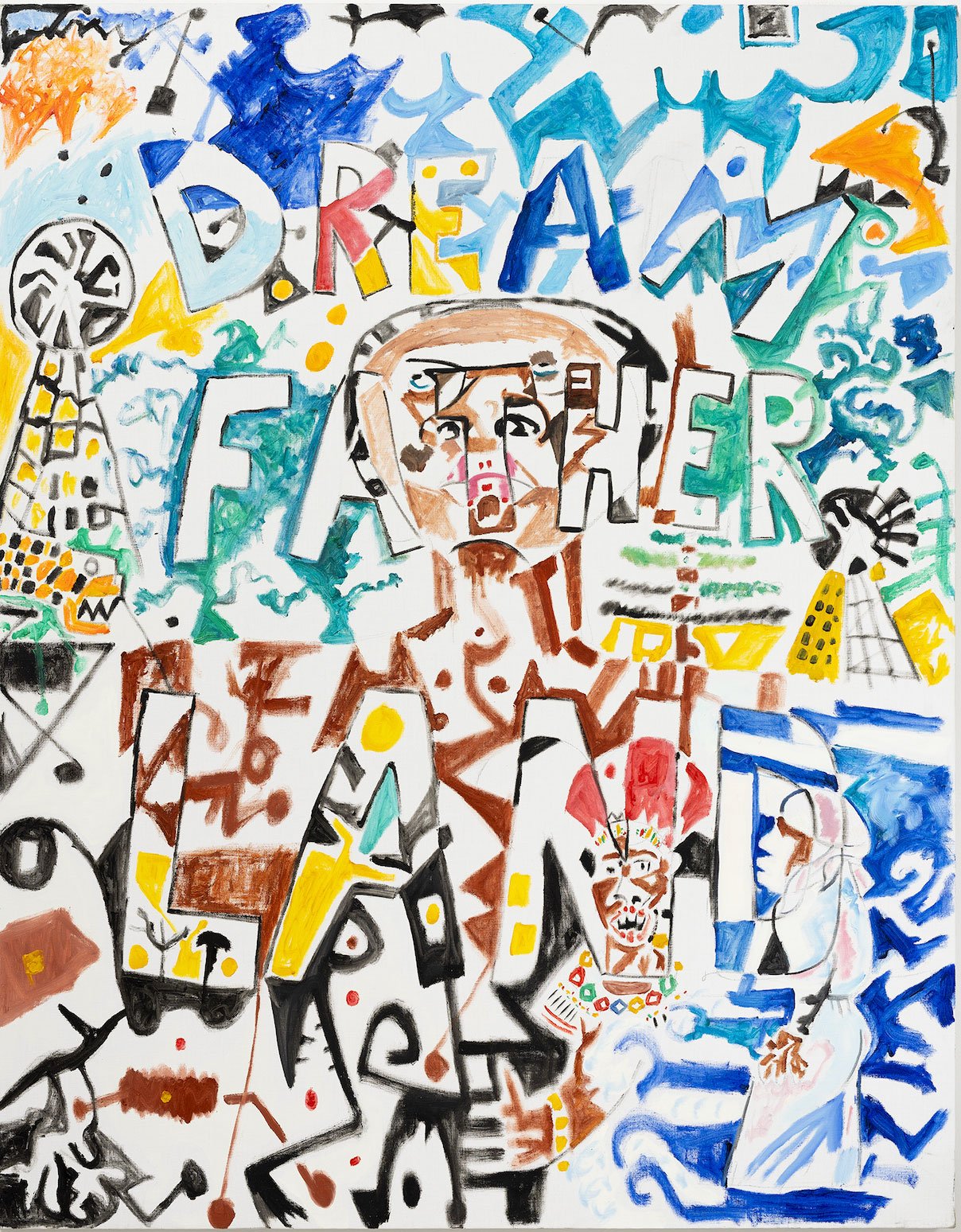
Wonga Mancoba’s paintings and drawings form a layered and highly personal visual language in which text and image are inseparable. Words and letters appear across the surface, emerging and dissolving within dynamic compositions built from line, color and underlying drawing. His works draw on the visual vocabulary of urban life – transport systems, signage and advertising – while simultaneously engaging with mythology, memory and historical narratives.
Recurring themes include slavery, diaspora and the violent erasure of place. In works referencing Sophiatown in Johannesburg, Wonga Mancoba explores the relationship between lived experience and inherited history through fragmented and often deliberately dissonant compositions.
The exhibition takes its title from the painting Dream of the Fatherland (2009), which encapsulates a central concern in Wonga Mancoba’s work: the idea of “fatherland” as something imagined, unstable and shaped by both personal and collective histories.
The presentation includes large-scale paintings, smaller works addressing social and historical themes, and an extensive selection of works on paper that highlight his engagement with drawing, writing and urban experience.
The exhibition is made possible through the work of Ferlov Mancoba Foundation. It also coincides with what would have been the artist’s 80th birthday on June 6, as well as upcoming presentations in Stockholm and Berlin.
Kilde:
Galerie Mikael Andersen
Galerie Mikael Andersen