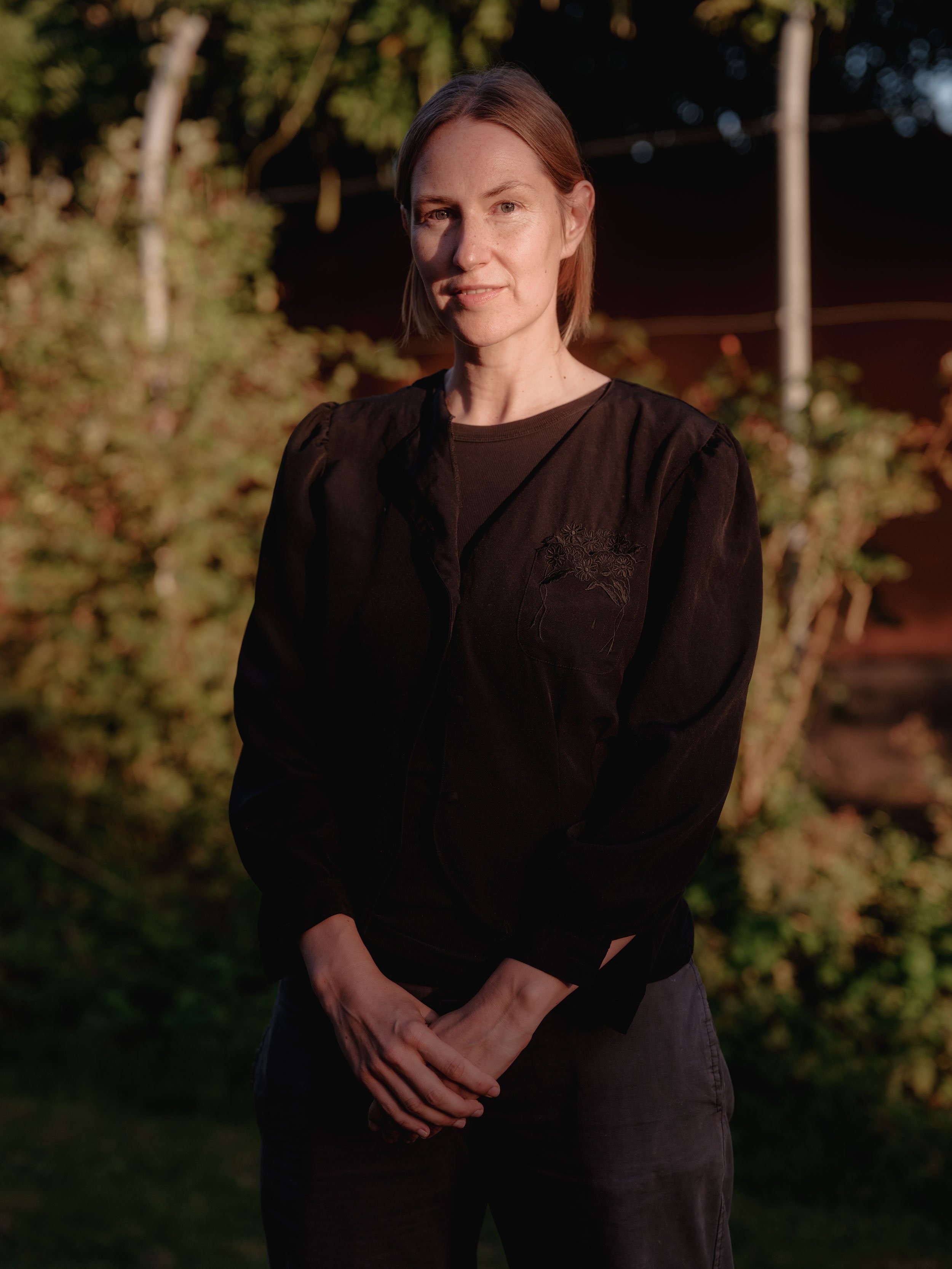
We take more photographs than ever before, yet few images make us see the world afresh. Tine Bek’s photographs invite us to look again at the things we think we know. Her extraordinary eye for colour, form and texture has made her one of the most distinctive voices in Danish fine art photography.
In Bek’s photographs, a piece of butter becomes a horse. An orange’s navel becomes almost human. A teacup, a spray of wisteria, her mother’s hands and her niece’s face are treated with equal seriousness. She moves between still life and portraiture with a curiosity that makes the hierarchy between people and everyday objects seem less self-evident. The butter horse has the weight of a monument, even as it struggles to hold its shape. The orange becomes strangely bodily, as though its peel were skin. There is humour in these shifts, but also tenderness towards all that changes.
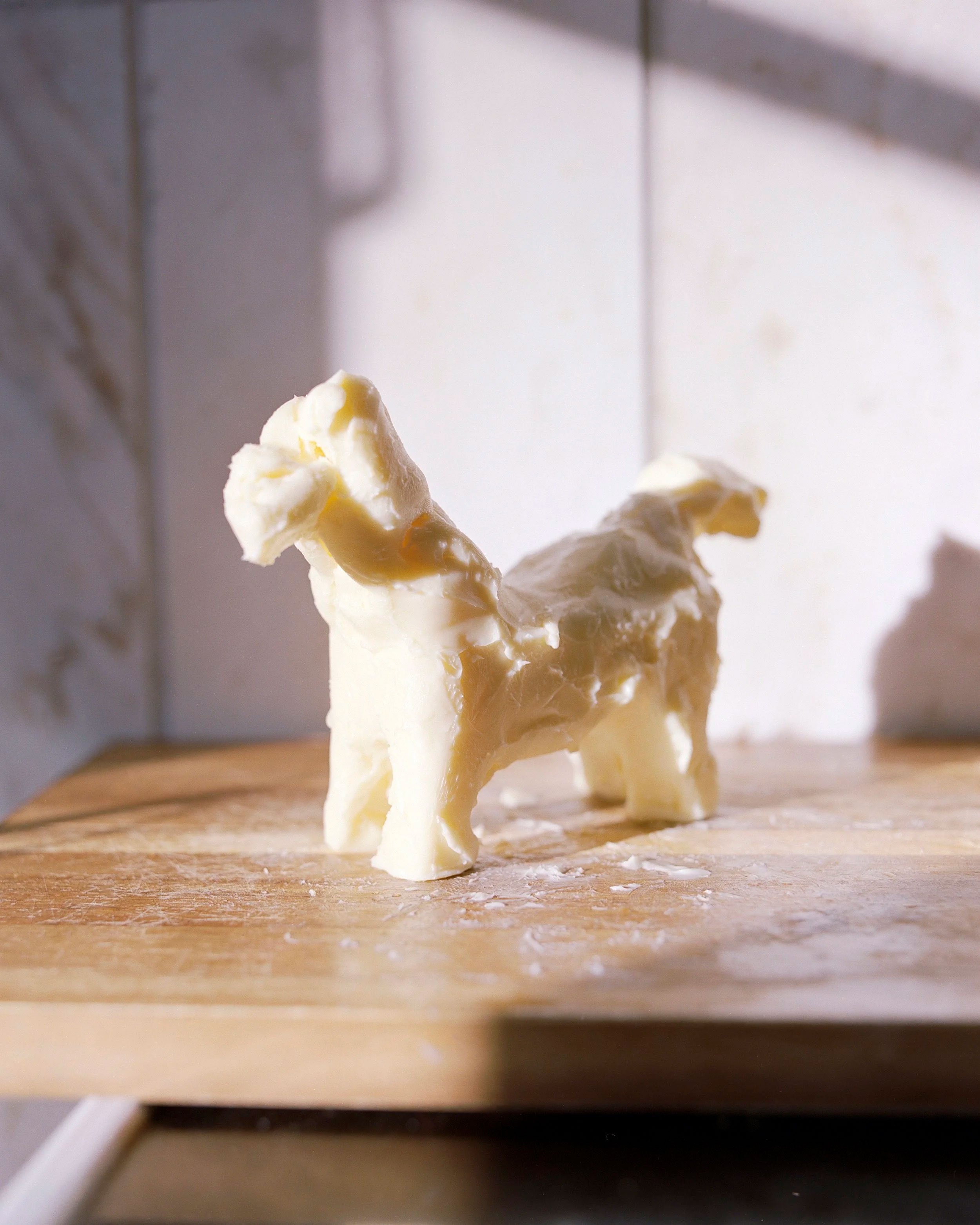
Tine Bek: Butter Horse. Credit: Tine Bek
The sensuousness lies in the details: the folds of skin, the soft surface of butter, the drape of fabric and the grain of a scanned negative. Bek shoots on film and works across photography, film and sculpture. Intuition drives her practice, and her images hold connections she senses before she can explain them.
At Faaborg Museum located on Faaborg Fjord on the Danish island of Funen, her work finds a new context in the exhibition Tingene imellem os – Between Us and Things. Here, curator Sofie Bastiansen has brought works by the Funen Painters into dialogue with contemporary art by Rose Eken, Sarah Becker, Ann Linn Palm Hansen and Tine Bek. Working across different media, the four artists explore how everyday objects tell stories about our lives and relationships.
We spoke to her about finding her way into photography, her exhibition at Faaborg Museum, working with butter as a sculptural material, and giving a fleeting moment a lasting form.
About Tine Bek
Tine Bek trained at Fatamorgana and Glasgow School of Art. Her work is held in the National Collection of Photography at the Royal Danish Library. In 2024, she presented the solo exhibition "This Ship is Unsinkable" at Fotografisk Center, and in 2021 she received the Hasselblad Foundation’s Photobook Award for "The Vulgarity of Being Three-Dimensional".
I could sense that a photograph could express something I couldn’t put into words.
Tine Bek
When did photography become a means of artistic expression for you?
I grew up surrounded by images and have been taking photographs for as long as I can remember. My grandfather on my father’s side was an amateur photographer, and my father gave me my first proper camera. My family has always been very keen on sport. My father and uncle both played football at a fairly high level when they were young, and my grandfather always went along to photograph the matches and record them on cine film. I have so many boxes of his negatives from football matches in the 1970s.
In my childhood home, we had a poster hanging in the kitchen of bulletproofglass #1 by the Australian artist Rosemary Laing. It shows a bloodied bride suspended against a blue sky. I was fascinated by the fact that you couldn’t tell whether she was rising or falling. I didn’t necessarily understand the image, but I kept thinking about the stories it might tell. I could sense that a photograph could express something I couldn’t put into words.
Pop culture and Lars von Trier’s films made me want to become a film director when I was growing up. But it was at Fatamorgana, the photography school, that I found my own voice as a photographer. I began to understand how the images I had grown up with had influenced me, and how making my own photographs could be a way of thinking and asking questions. I realised that an image could reveal new possibilities long after I had photographed it.
After Fatamorgana, you studied at the Glasgow School of Art and stayed in the city for several years. How did those years shape you as an artist?
Glasgow showed me the kind of life I wanted to lead as an artist. There was a strong belief that you could create opportunities for one another, whether by opening an exhibition space or publishing a book. That sense of community was part of the work itself. It shaped my understanding of what an artistic practice could be, and how much you could make happen yourself.
I also worked at The Common Guild, which was based in a townhouse owned by the artist Douglas Gordon. The first exhibition I helped install was by the German artist Wolfgang Tillmans. His work made a huge impression on me, and the gallery’s programme became an important part of my education as an artist. I was able to spend time with the works up close and see how they worked within a space.
At the same time, I started Earth Saga Press, publishing zines: small, independent publications produced in limited editions. The first issue brought together women photographing women; the next explored masculinity. For the final issue, I asked contributors to describe what they had done on 2 September. Without a single photograph, it became a portrait of a day and of the different lives unfolding alongside one another.
The city itself also shaped my eye. Glasgow combined a certain roughness with the warmth of its people. There were grand façades and decorative details, things that were worn and things that were a little tacky. That mixture gave me the freedom to bring different styles and sensibilities into my photographs. Even the unpredictable light became an incentive to work. I began arranging subjects and creating the situations I wanted to photograph.
You’ve been working with photography for almost two decades. How has your way of seeing changed?
I’m more aware of how I look at things, but I also feel freer. A horse, a piece of fruit or a carefully arranged still life can open up a whole world of associations. I see more possibilities in each subject and more connections between photographs. Something I photographed in one context can take on an entirely different meaning when I return to it later.
I also think fine art photography has become more diverse, with more women helping to define it.
Tine Bek
I also think fine art photography has become more diverse, with more women helping to define it. That broadens our understanding of who can be an artist and what a photograph can express. As more people find a place behind the camera, a wider range of experiences and perspectives comes into view.
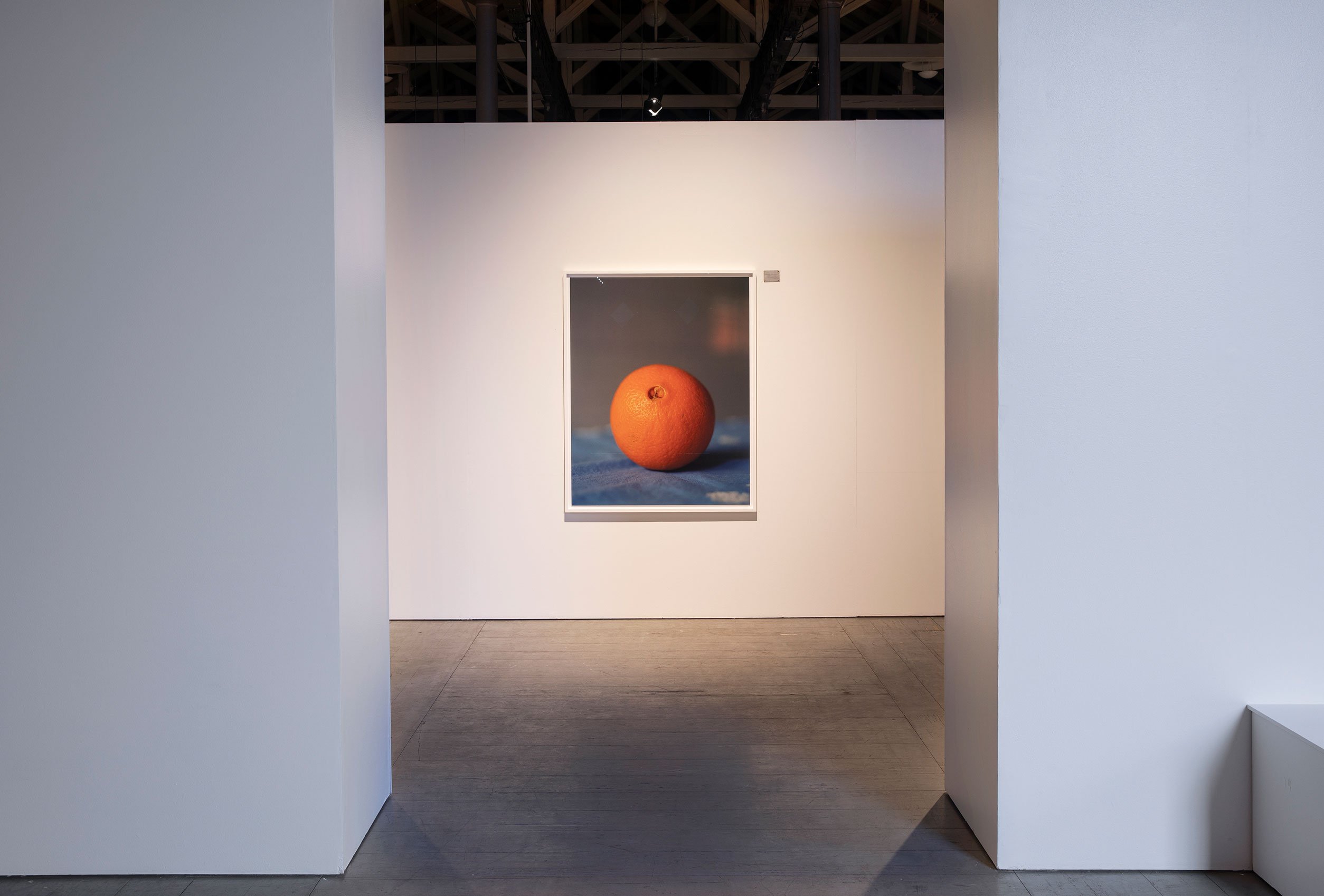
Exhibition view Tine Bek: This Ship is Unsinkable at Fotografisk Center, 2024. Credit: Tine Bek
What makes you want to photograph something?
It often starts with an atmosphere, a colour or a particular quality of light. Something feels slightly off or ambiguous, and it makes me look again. It’s very intuitive. I don’t always know why something holds my attention, and I don’t need to know straight away.
My two-year-old daughter is always saying she wants to bring things home: ‘Mum, I want to take the moon home,’ or ‘The horse is coming home with us, isn’t it?’ I recognise that urge. When I take a photograph spontaneously, it’s often because I’ve seen something I want to take with me.
The photographs become a kind of archive of moments I find difficult to let go of. I can return to them and bring them together in ways that suggest stories I could never have imagined when I took them. So part of the work is discovering what happens between the images.
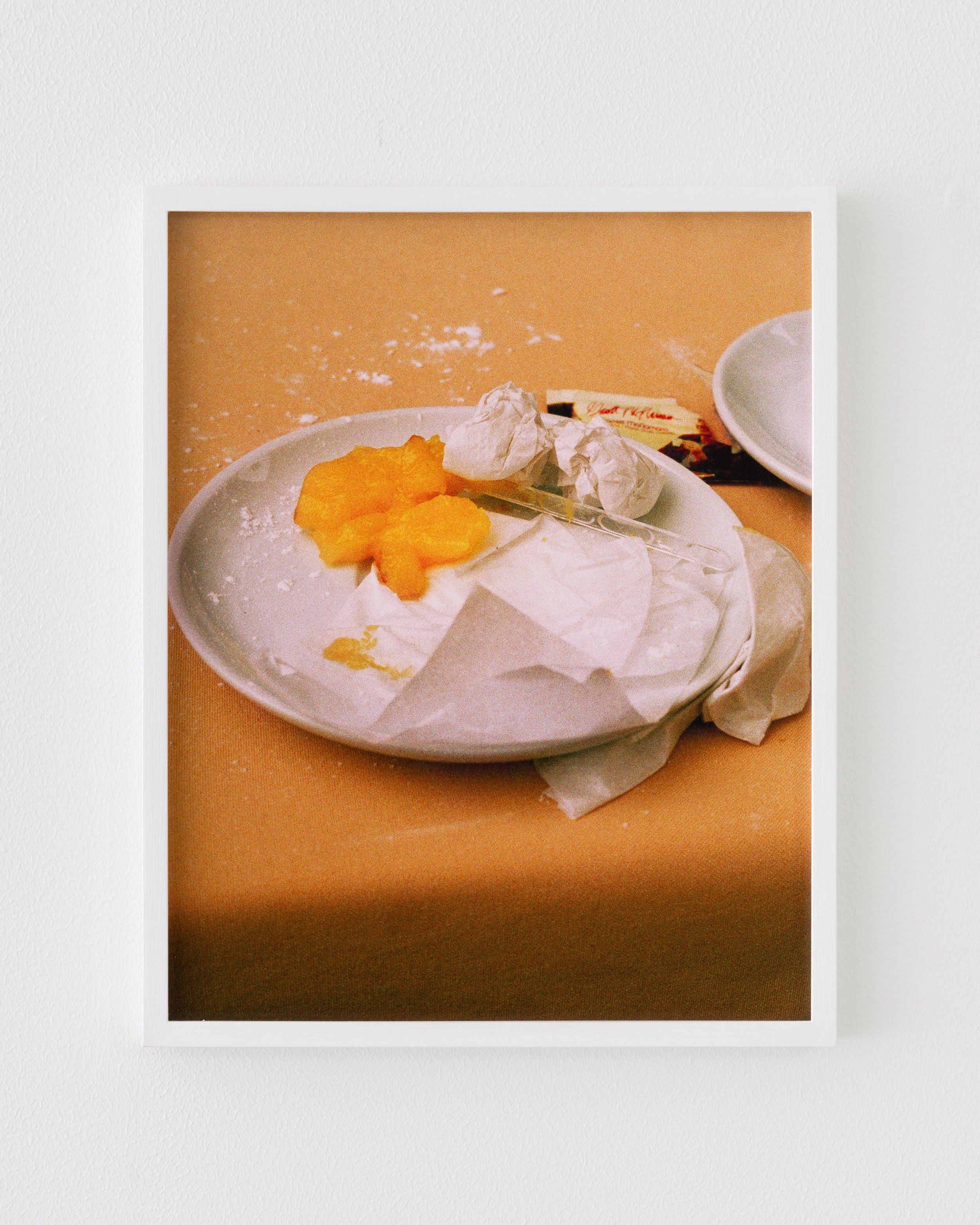
Tine Bek: Doughnut Dust. Photo: Jacob Friis-Holm Nielsen
You work with both film and digital photography. How do the two processes affect your images and the way you work?
I shoot on film for my own artwork and usually work digitally on commercial commissions. Working with film changes the pace. I also love the negative as a physical object. The image exists on a tangible material that I can continue to work with.
When I scan a negative, I look at how the colours and grain shape the image. That’s part of developing the look and feel of the photograph. The process affects what I pay attention to when I’m taking the picture, as well as what I notice afterwards. I’m interested in how the camera renders the surface of a subject, and how the photograph develops a texture of its own.
You’re currently showing in Tingene imellem os – Between Us and Things. at Faaborg Museum. What is it like to see your photographs in those rooms?
Faaborg Museum is an extraordinary experience for the senses. Carl Petersen’s building, completed in 1915, was designed to house the work of the Funen Painters. The bold wall colours, patterned floors and the way you move from one room to the next make the building itself part of the experience. Colour, architecture and artworks were all conceived as a whole.
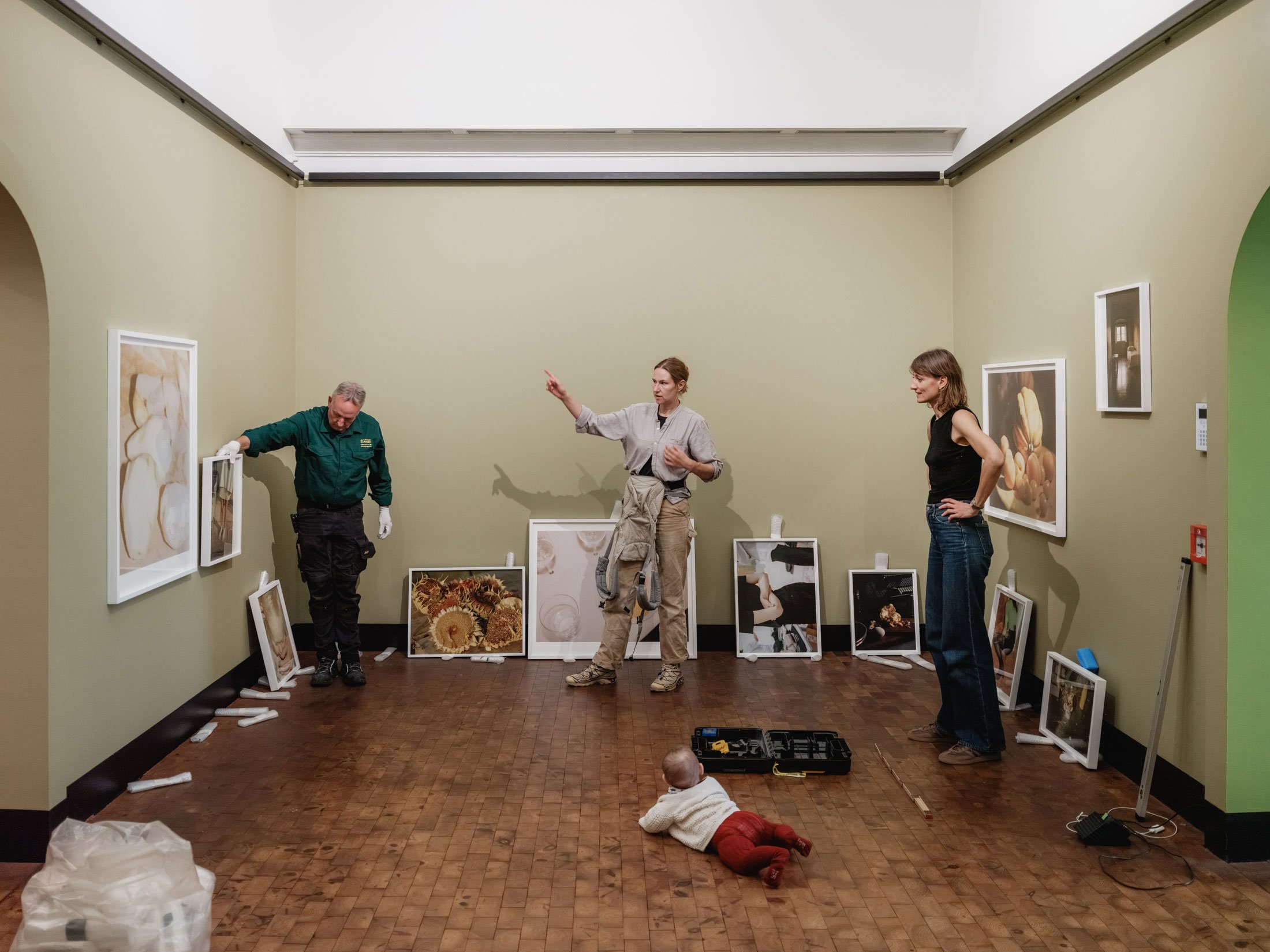
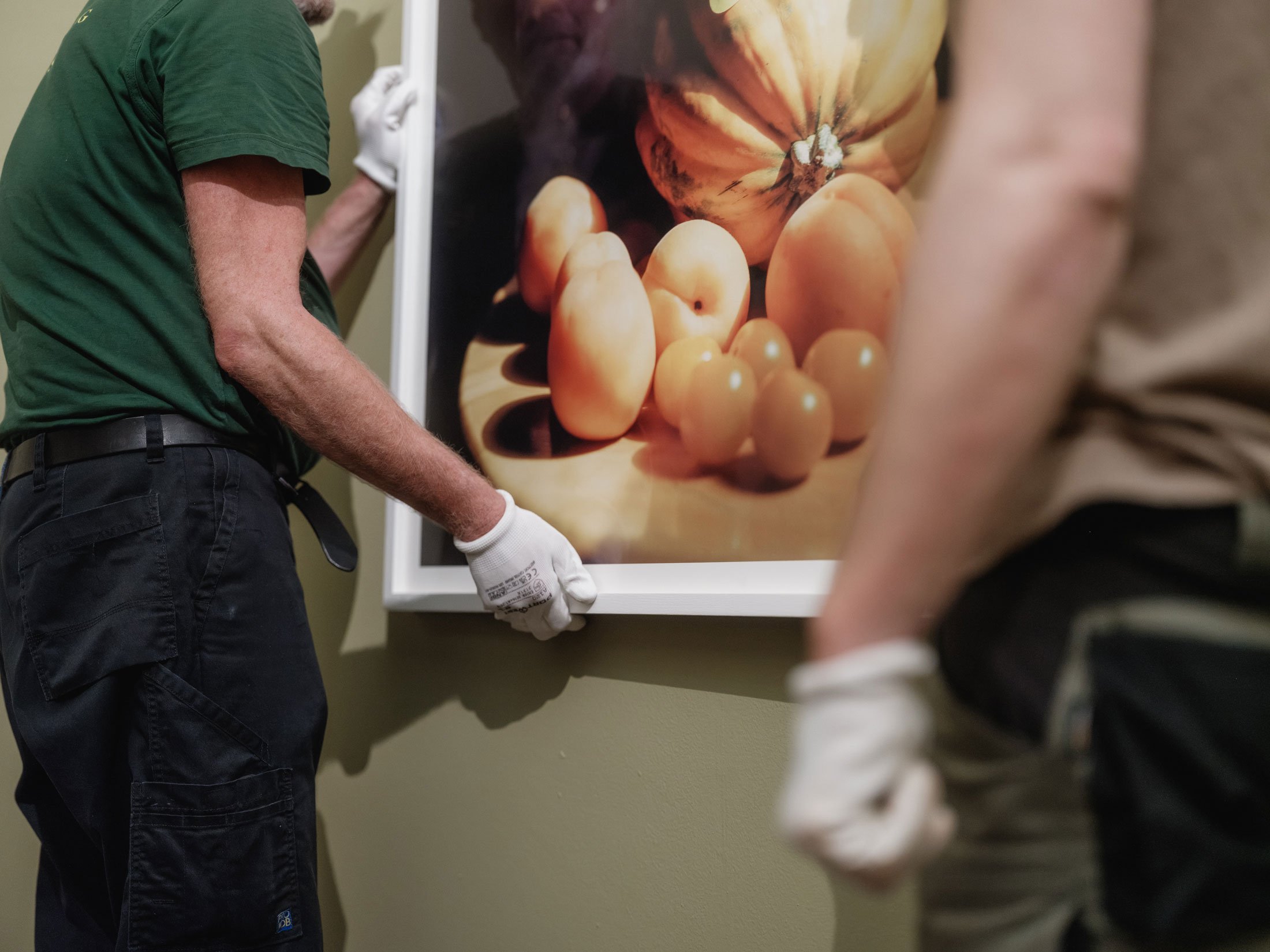
Tine Bek (centre) during the installation of the exhibition Tingene imellem os – Between Us and Things at Faaborg Museum. Photo: Andreas Bastiansen
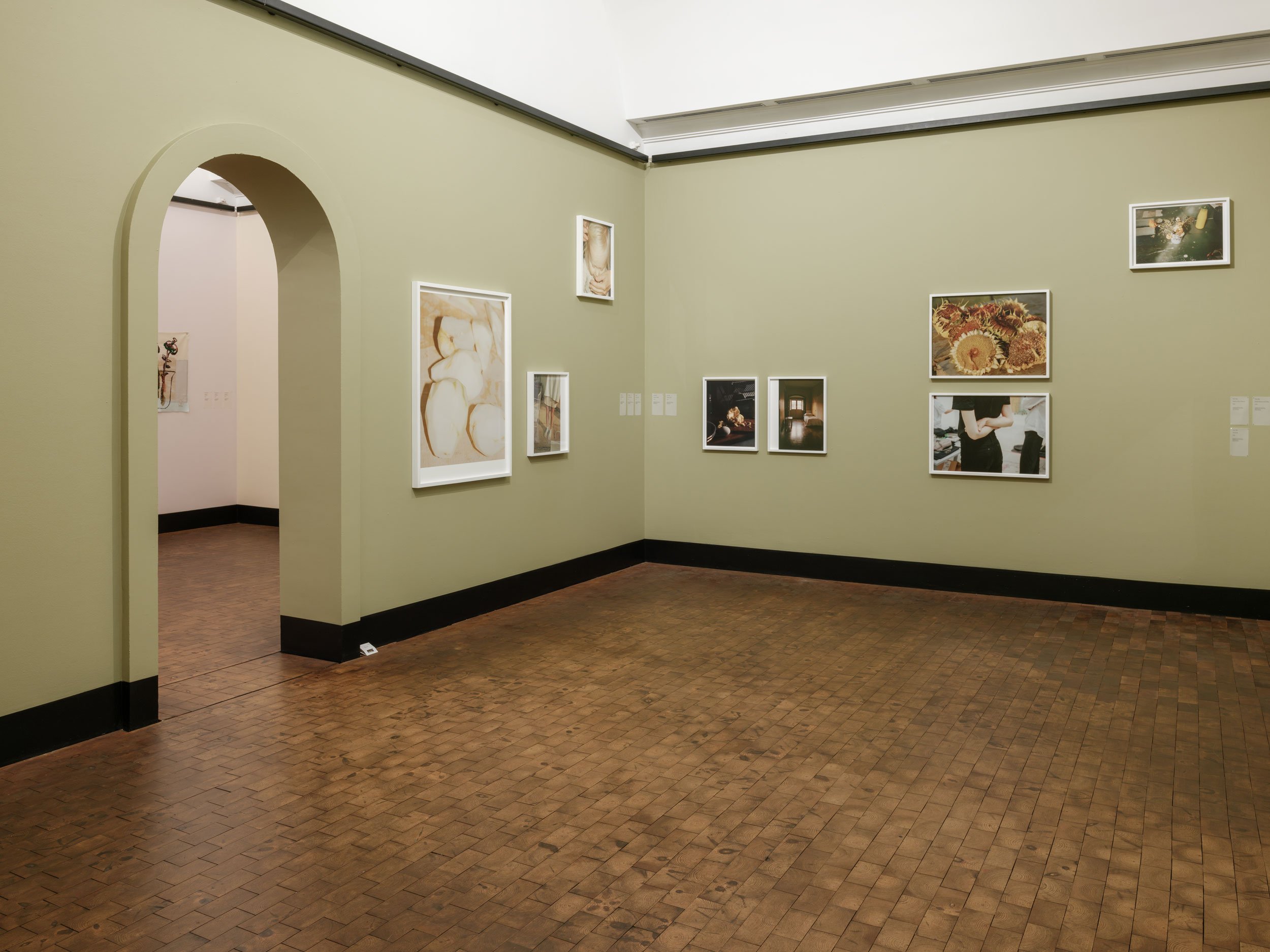
Detail of Tine Bek’s works in the exhibition Tingene imellem os – Between Us and Things at Faaborg Museum. Photo: Andreas Bastiansen
It’s inspiring to see my photographs in that setting. The colours around a picture affect what you notice in it, and showing my work alongside the collection reveals connections across time. Working with the curator Sofie Bastiansen to find those connections has been very rewarding.
It has also been a pleasure to exhibit with Rose Eken, Sarah Becker and Ann Linn Palm Hansen, all of whom I greatly admire. Our work looks very different, but we share an interest in everyday things. Seen together, the works bring out new aspects of one another and encourage viewers to look at familiar subjects differently.
I’m interested in the traces we leave behind.
Tine Bek
The exhibition centres on still life, a genre in which flowers, fruit and objects take the leading roles. What interests you about it today?
I’m interested in the traces we leave behind. A table where someone has just eaten. A knife lying at a particular angle, an empty glass. The people have gone, but you can still feel their presence. I’m drawn to the moment that has just passed, or the one that is about to happen. These objects suggest a life that continues beyond the frame.
Still life also has a special place in the history of women artists. Many women worked in the genre partly because they had limited access to art education and training. I’m interested in how flowers, fruit and everyday objects gave them scope for great artistic ambition. A subject doesn’t have to be grand to say something important.
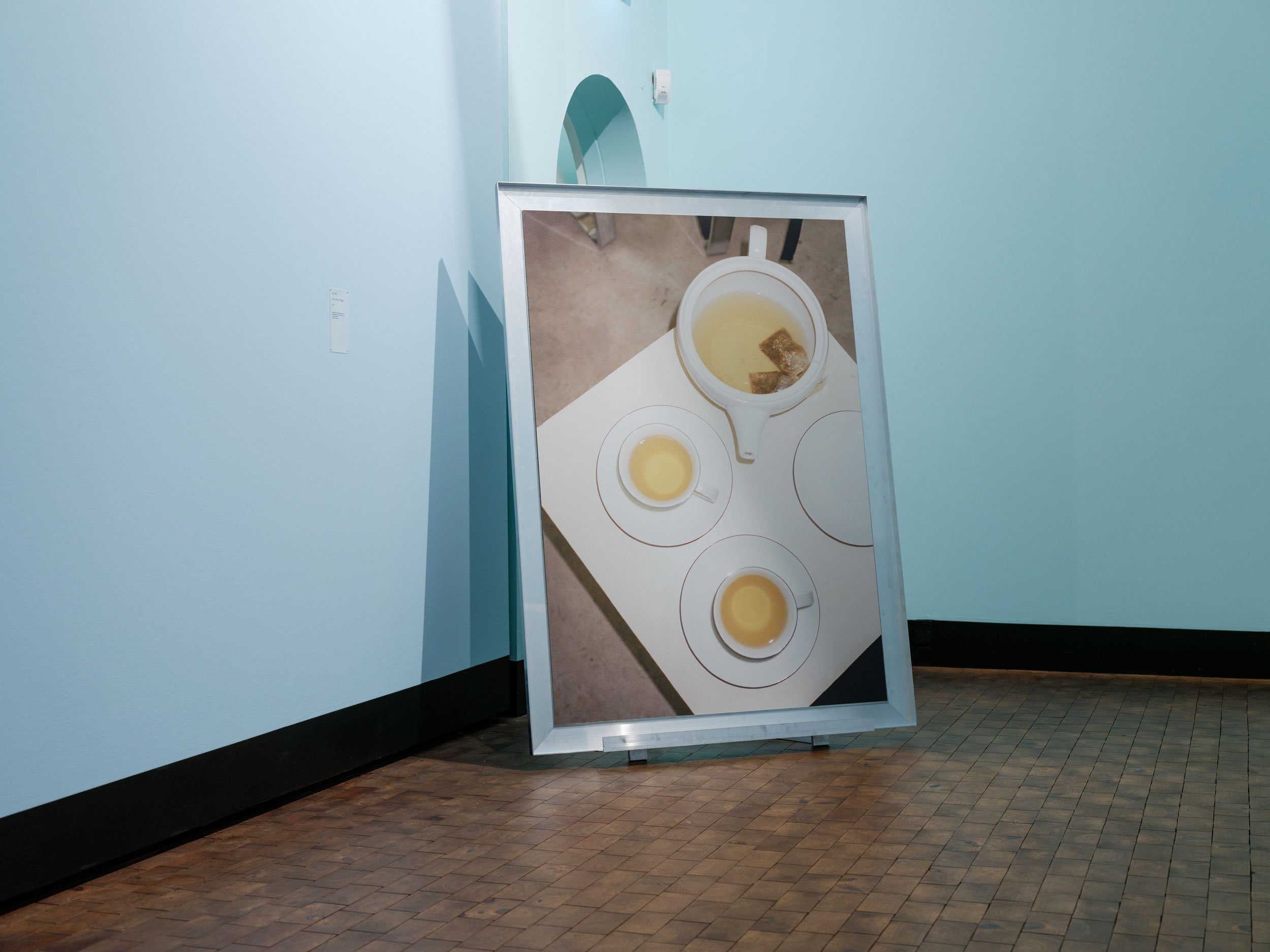
Detail of Tine Bek’s works in the exhibition Tingene imellem os – Between Us and Things at Faaborg Museum. Photo: Andreas Bastiansen
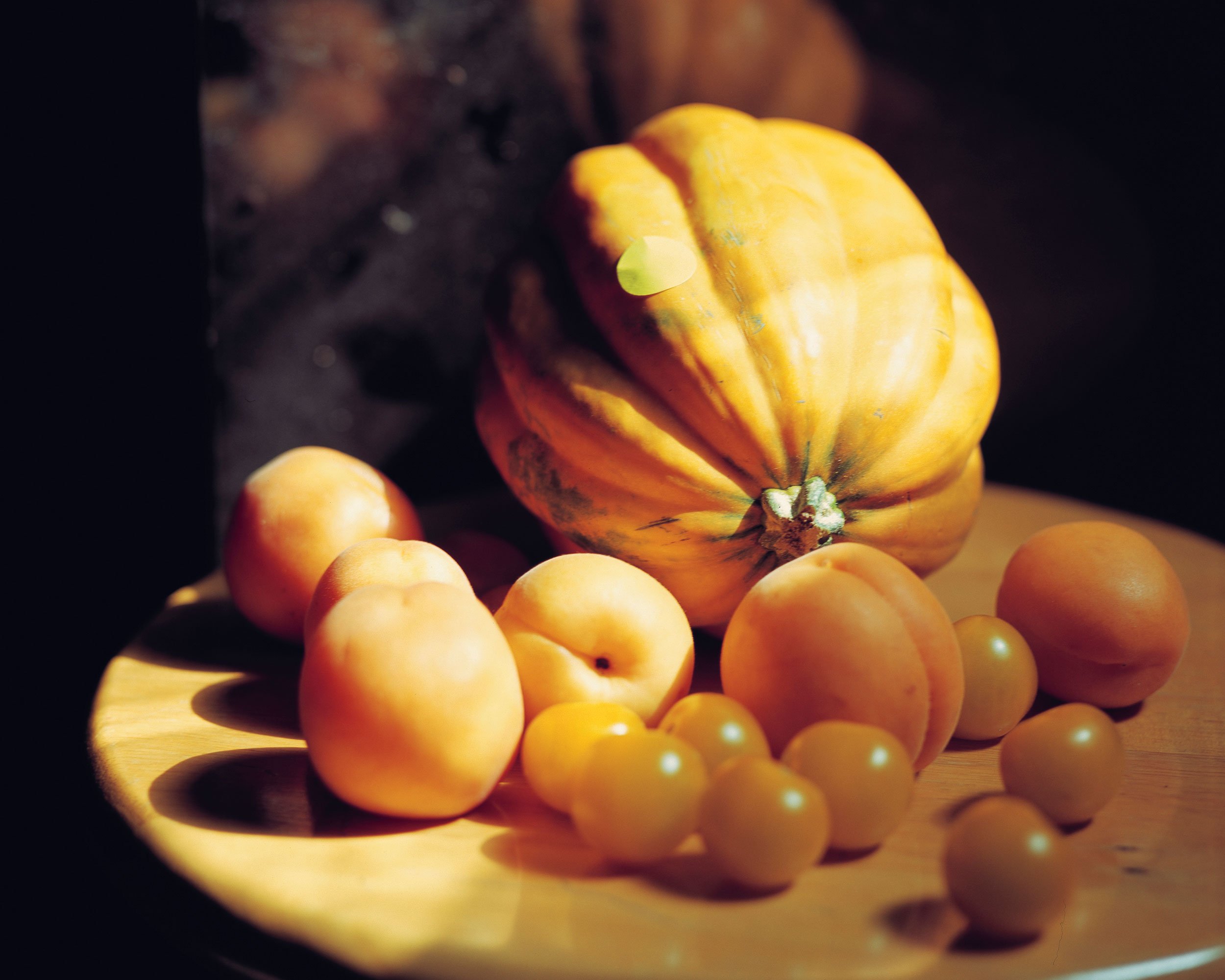
Tine Bek: Yellow Still Life In The Basement. Credit: Tine Bek
The Funen Painters Anna and Fritz Syberg have been a particular source of inspiration. What do you recognise in their work?
I recognise the daily demands of life with children, and the longing to have time to work. I’m moved by the creative drive I see in Anna Syberg’s paintings because I know what it’s like to try to balance family life with making art. I’ve also spent a lot of time looking at her colours and the delicate, almost fleeting quality of her watercolours.
With Fritz Syberg, it’s the children and the everyday scenes that move me most: a family gathered around a bowl of rice pudding, for instance. The paintings belong to another time, yet they feel so close. I recognise the life in them, even as I’m reminded that it’s long gone. That’s what moves me: a picture can bring us so close to something we can never return to.
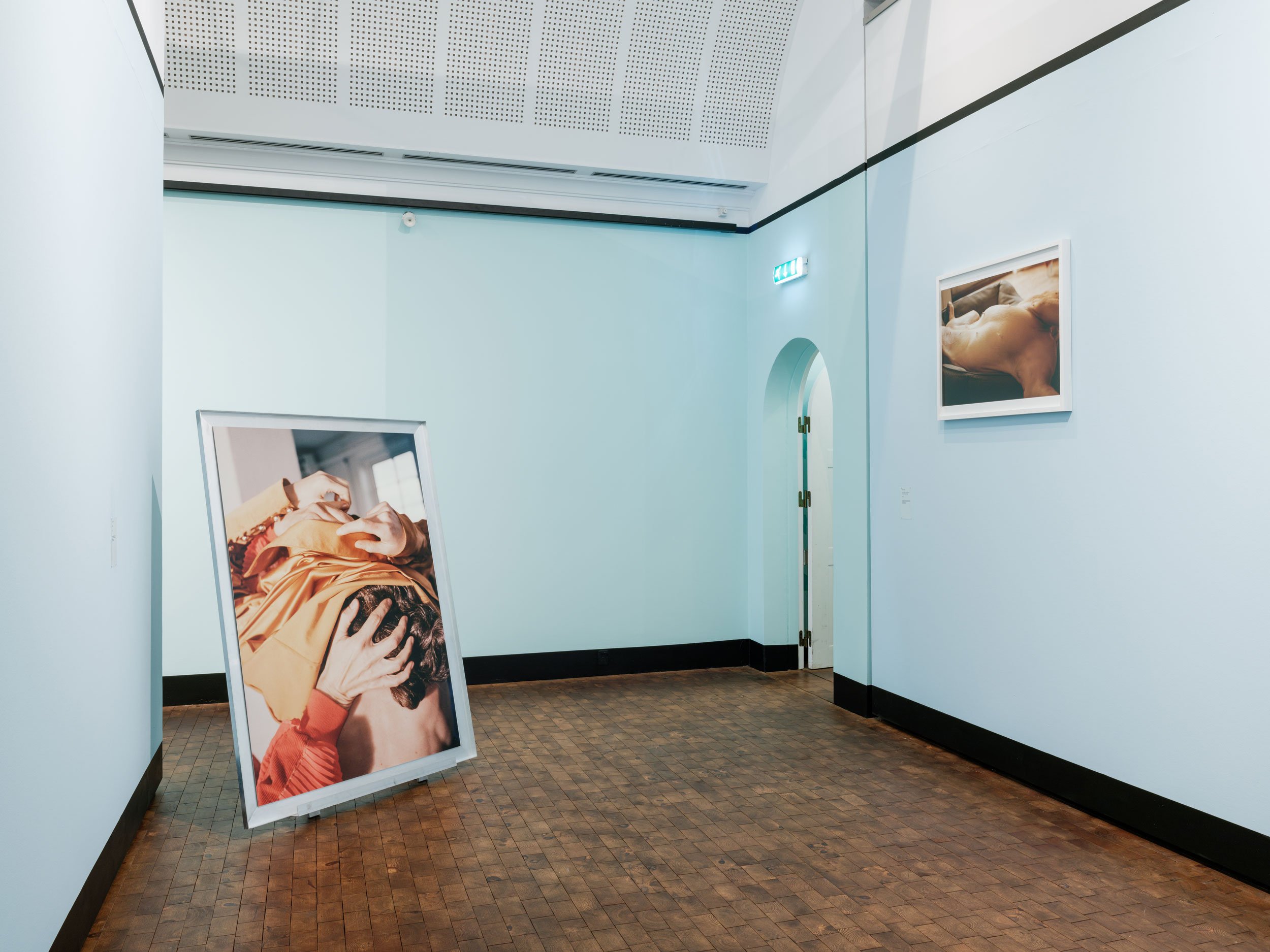
Detail of Tine Bek’s works in the exhibition Tingene imellem os – Between Us and Things at Faaborg Museum. Photo: Andreas Bastiansen
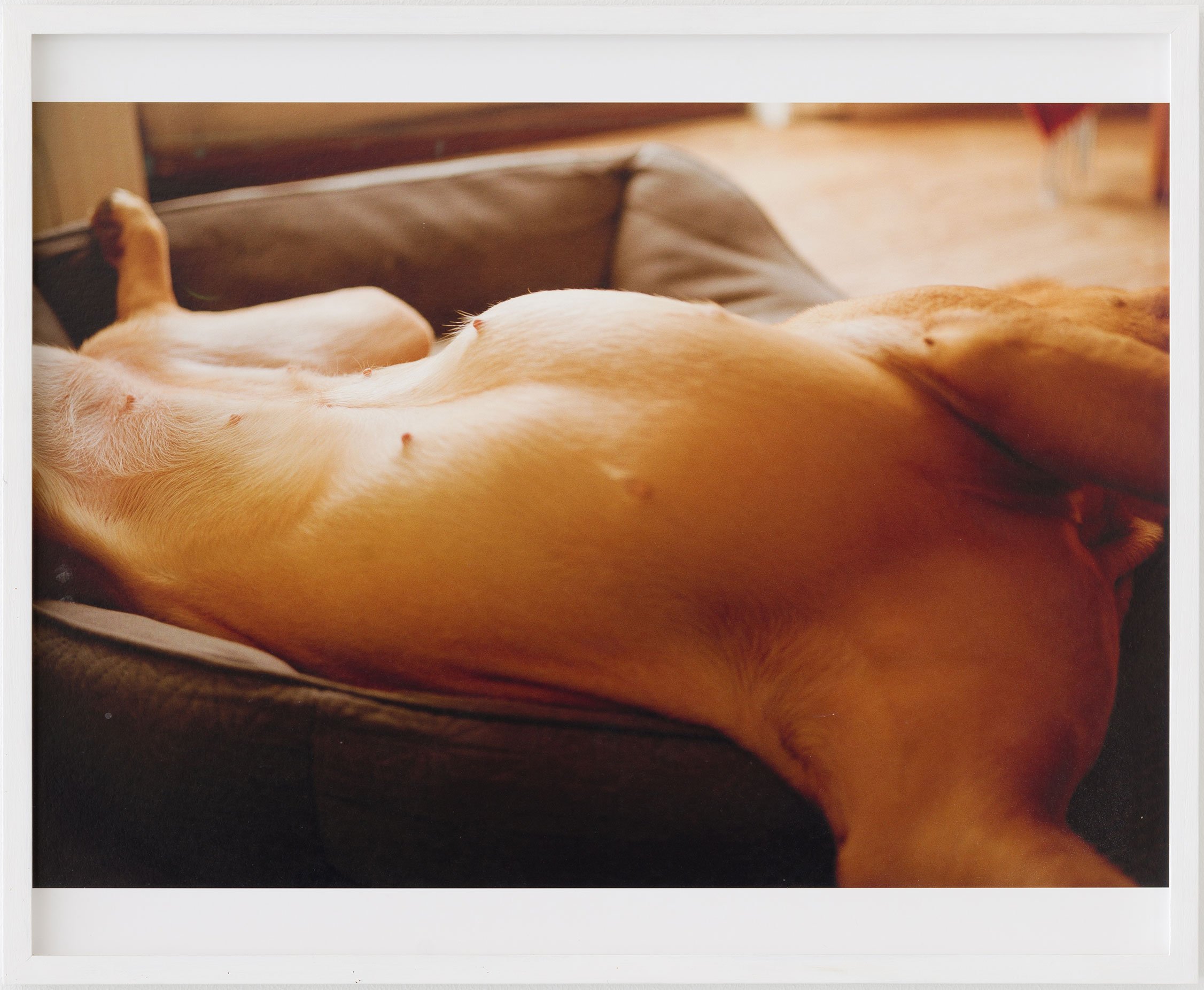
Tine Bek: Draw me like one of your french girls. Photo: Jacob Friis Holm Nielsen
How do everyday life and the passage of time come together in the works you’re showing here?
I’m showing 21 works, with subjects ranging from teacups and butter horses to my niece’s face, wisteria in London and my mother’s hands. Together, they bring different times and places in my life into contact. Connections emerge through colour, shape and texture, even though the pictures were taken in very different circumstances.
I’m moved by how quickly time passes and how beautiful everyday life can be.
Tine Bek
I’m moved by how quickly time passes and how beautiful everyday life can be. Often, it’s only when I look at the photograph that I realise how much there was in what seemed like a small moment. The picture lets me see it again, but also understand it differently.
Several of your photographs feature horses you’ve modelled in butter. How did you begin using butter as a sculptural material?
During lockdown, I read about the sculptor Anne Marie Carl-Nielsen making crows out of butter because she couldn’t find any clay. I was struck by that urge to create: wanting so much to give something form that you use whatever happens to be at hand. I started modelling horses in butter and photographing them.
The butter reacts to the warmth and gradually loses its shape, which makes the sculptures seem strangely alive. I can model them, but the material keeps changing them. The photograph captures a particular moment in that process.
Recently, I made a butter sculpture of a dog peeing and had it 3D-scanned. The idea is to cast it in bronze. I’m interested in how our response to a form changes when it is made from a different material. Butter is familiar and perishable, while bronze carries associations of permanence and the history of sculpture. It gives the figure a different weight, both literally and in our eyes.
When the butter sculpture changes but the photograph remains, where does the artwork exist?
That’s a question I keep coming back to. A photograph can give a fleeting form an authority it never had as an object. A sculpture that stayed upright for only a moment can look monumental in a picture.
The angle, light and framing all contribute to that effect. The camera also decides what we never get to see. I’m interested in the gap between an object and its image: how a photograph can persuade us to believe in a form that was actually on the verge of falling apart.
Butter melts, flowers wilt, fruit rots and bodies age. What role does impermanence play in your work?
It plays a leading role. It’s already there in the material, before I do anything to it. Fruit ripens, bodies change, butter softens. The forms I work with are only ever temporary.
The more vividly a photograph brings a moment to life, the more keenly I can feel the distance from it.
Tine Bek
In a photograph, those forms can endure. We can go on seeing something we can no longer touch. There is something both beautiful and sad about that. The more vividly a photograph brings a moment to life, the more keenly I can feel the distance from it.
The fruit in your photographs seems almost human. What happens when we start to see a body in a piece of fruit?
We start to project our ideas about the body onto it. We see skin, marks, cellulite and belly buttons. I give some of the fruit human names, and suddenly a particular shape seems to have a personality. I’m interested in how little it takes for us to read something human into what we’re looking at.
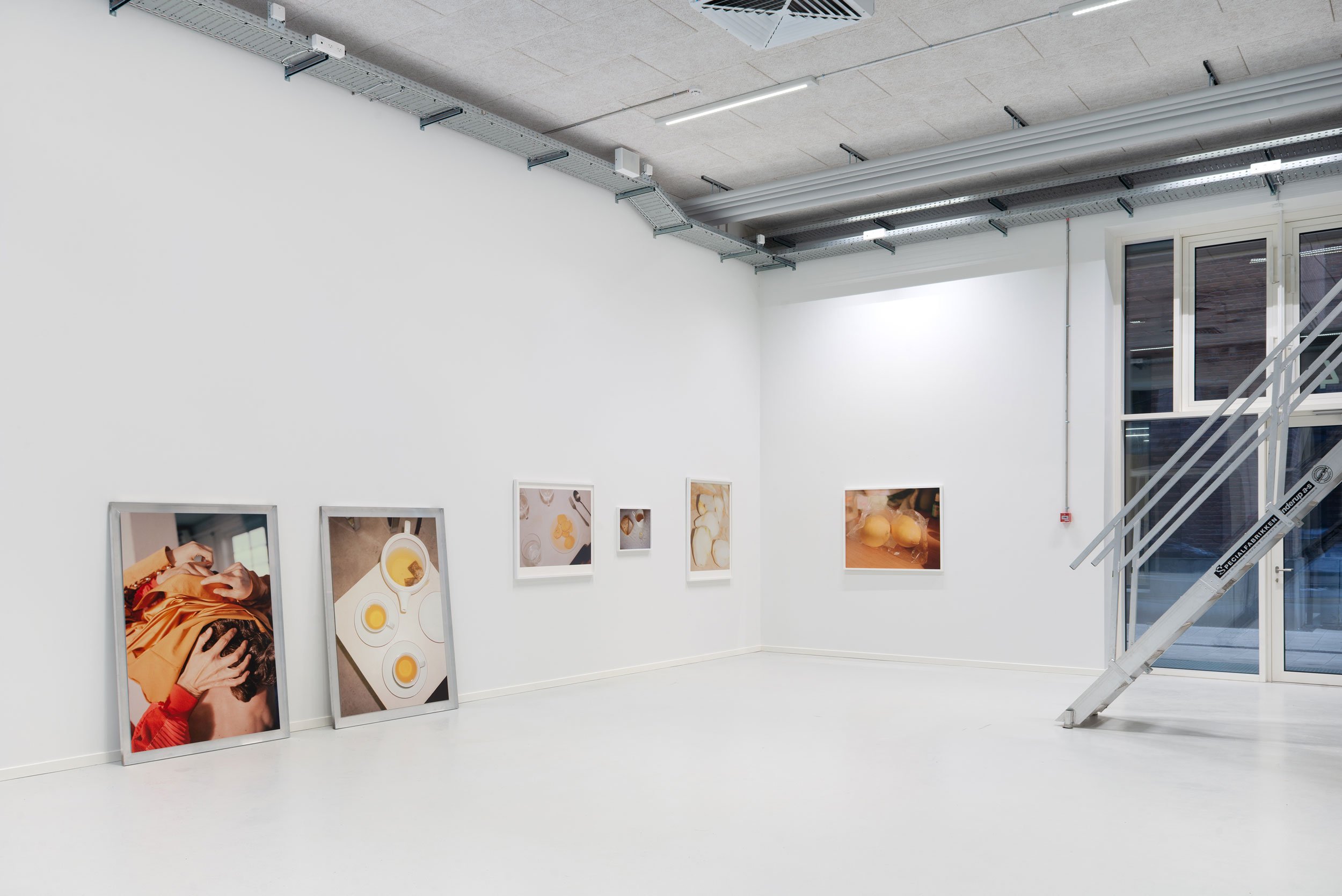
Tine Bek: Flower Bud. Annika Nuttall Gallery. Photo: Jacob Friis-Holm Nielsen
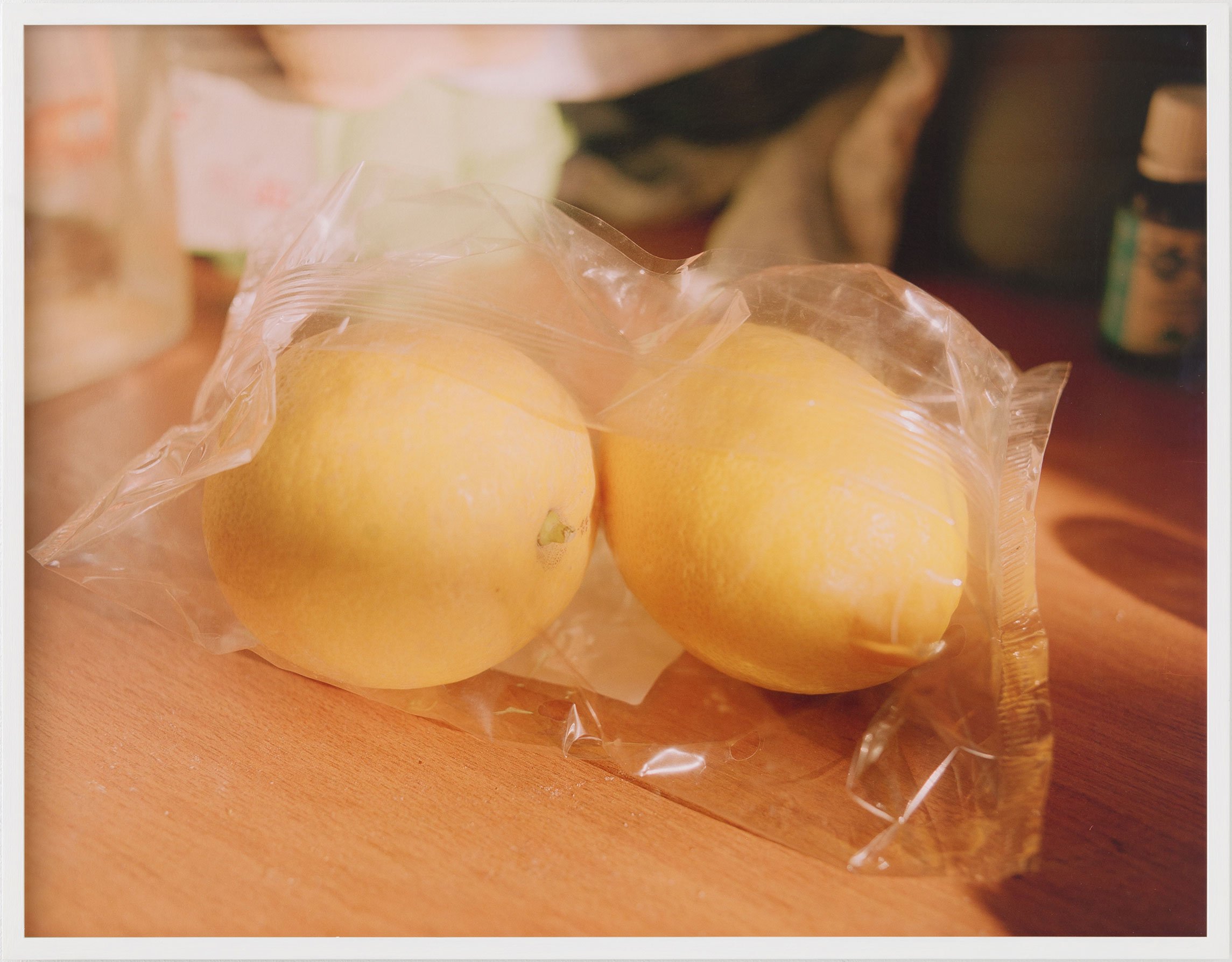
Tine Bek: Lemons. Photo: Jacob Friis-Holm Nielsen
Fruit also has a long history of associations with desire. Eve and the apple, the forbidden fruit: they’re there in the background. I like working with those clichés because they’re so deeply embedded in the way we see. Even the phrase ‘orange-peel skin’ links the fruit to a judgement about women’s bodies. A photograph can reveal those associations and play with them.
Your images can be both beautiful and unsettling. When does beauty become interesting to you?
When it makes me question the way I’m looking. I can be drawn to something and feel uneasy about it at the same time. A surface can be beautiful just as it starts to decay. I rarely think of beauty as a fixed quality that belongs to an object. It comes from the relationship between what I see and what I imagine. That’s why ambiguity matters. I want a picture to keep changing for the person looking at it, even though the subject stays still.
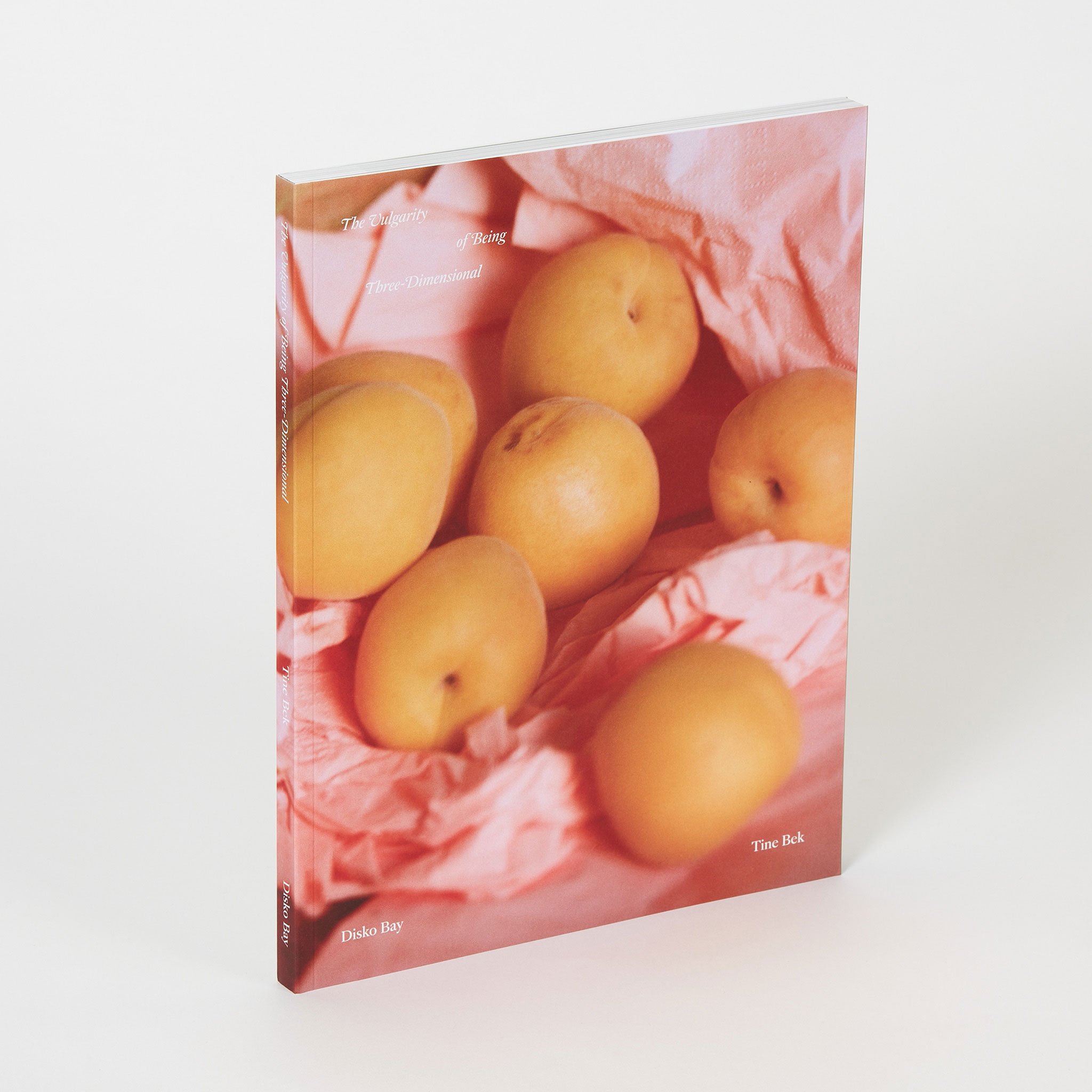
Cover of the publication Tine Bek: The Vulgarity of Being Three-Dimensional. Disko Bay Publishing, 2024.
Your book takes its title, The Vulgarity of Being Three-Dimensional, from a phrase in Karen Blixen’s story Carnival. What did it mean to you?
In Carnival, one of the characters complains about the vulgarity of being three-dimensional. The story plays with masks and identity, and with the relationship between who we are and who we imagine ourselves to be. I came across the book by chance during a residency in Portland. I felt out of place there, and the phrase gave shape to something I’d been struggling to put into words.
What does it mean to have a physical form? To be flesh and blood, to have weight and take up space in the world? I find that both funny and beautiful. But the word ‘vulgar’ also carries a judgement. Some things are considered refined, others common or inappropriate.
In my photographs, a body, a piece of fruit and a lump of material can all receive the same attention. I’m interested in what happens when those hierarchies begin to shift, and when something we wouldn’t normally value suddenly makes us stop and look.
My images work best together.
Tine Bek
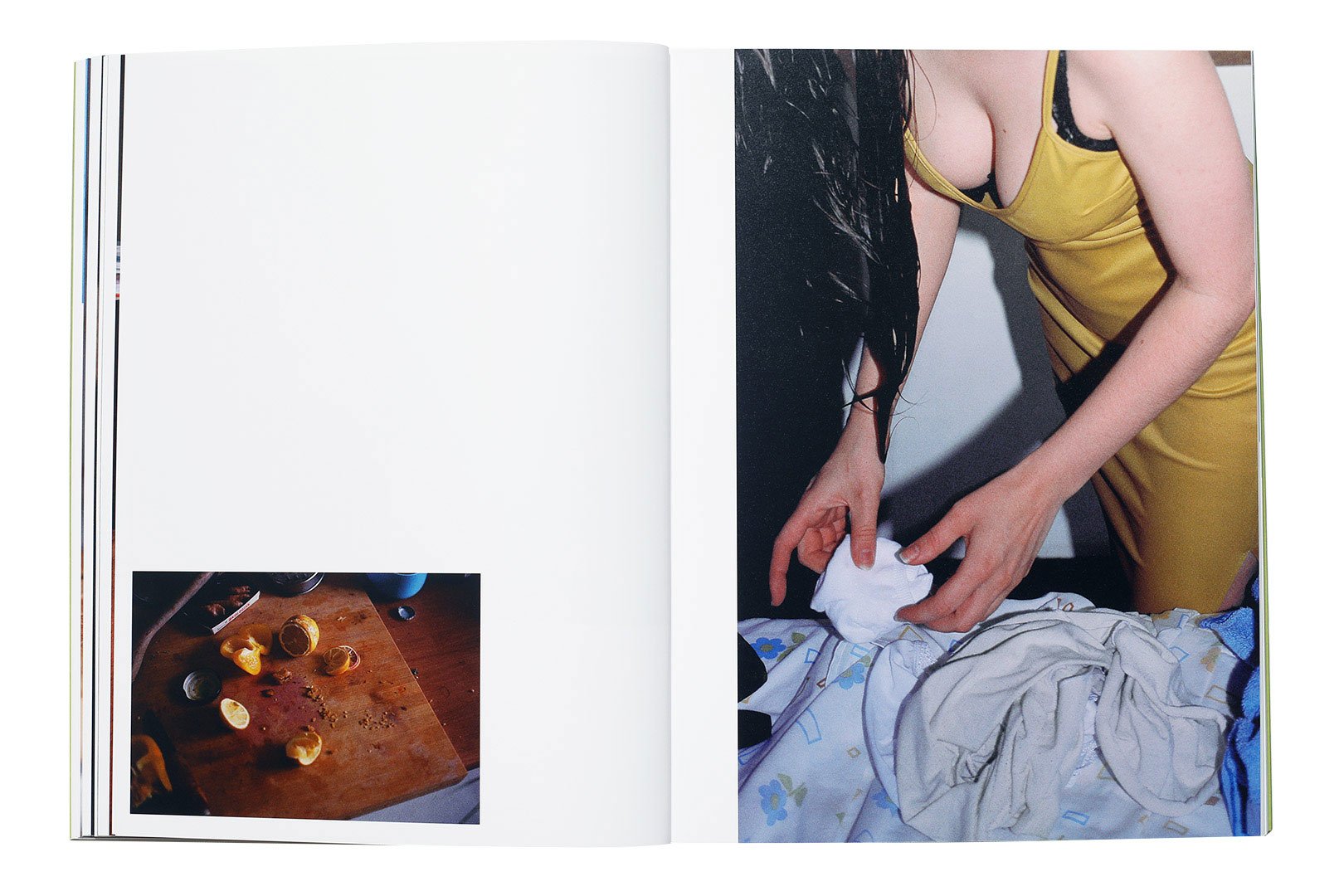
Pages from the publication Tine Bek: The Vulgarity of Being Three-Dimensional. Disko Bay Publishing, 2024.
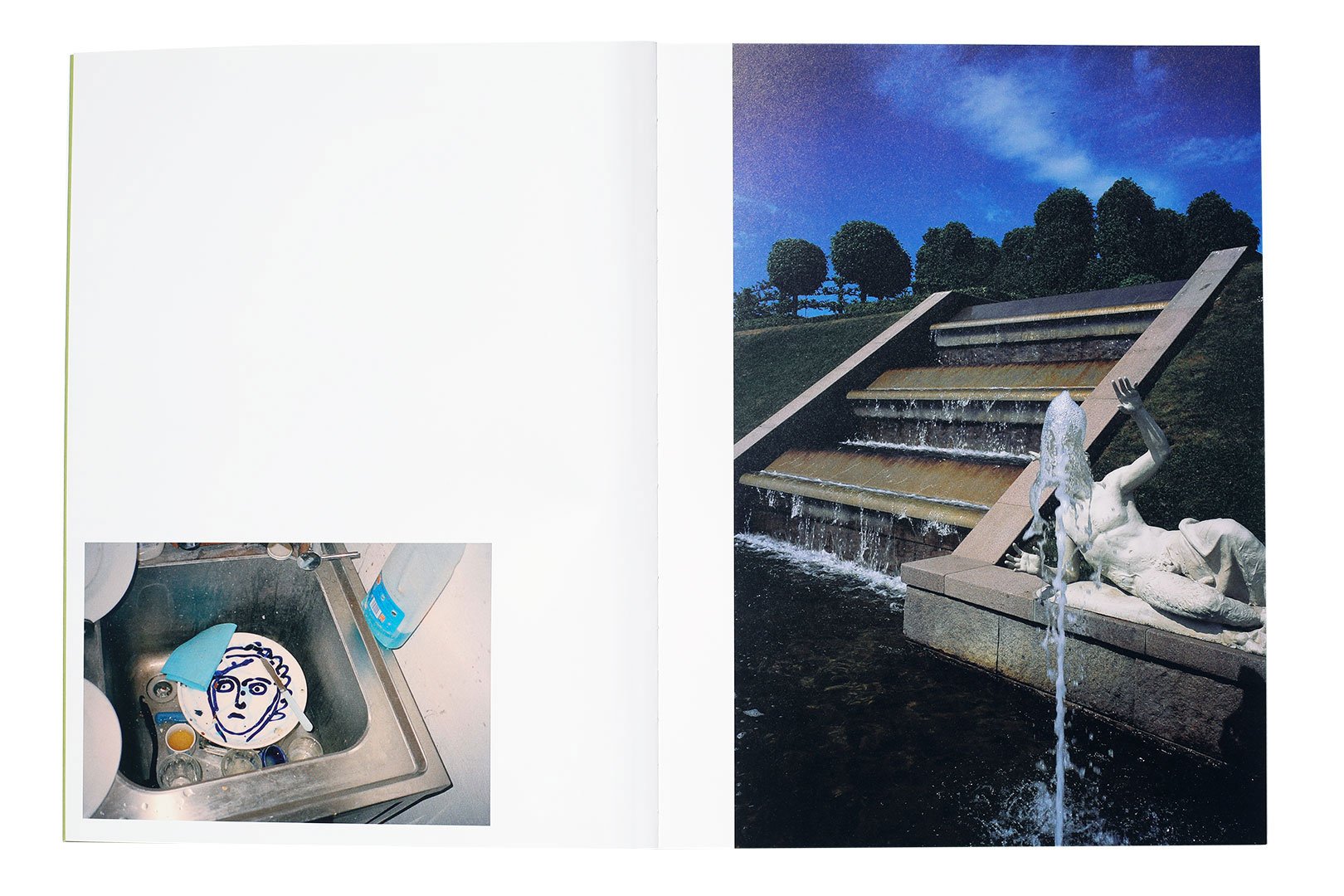
Pages from the publication Tine Bek: The Vulgarity of Being Three-Dimensional. Disko Bay Publishing, 2024.
What possibilities does the photobook offer as an art form?
My images work best together. Here they start to ask questions of one another. A shape can reappear in an entirely different context, and a picture that initially seemed calm can become unsettling because of the one that follows it. So bringing images together is an important part of the work.
I think of a book as a sequence, with pauses, changes of scale and a rhythm of its own. There’s something cinematic about it. But readers can set their own pace and turn back whenever they like. I often start at the back of a book myself. That freedom interests me: the way a sequence of images can suggest a story without dictating how it should be read.
You live in a country house with a large garden and lots of animals. How do your surroundings influence your work?
You become very aware of the seasons. The light changes, the garden takes on a different character, and something that was flowering a moment ago is suddenly gone. I’m surrounded by the same changes that interest me in my photographs. The animals keep me alert to what’s happening around me. My two dogs have such distinct personalities. Coco is a Dogue de Bordeaux and very French: she likes to be in charge and is incredibly stubborn. Luna is a Cane Corso and more Italian. She’d happily spend all day basking in the sun, and she’ll do anything for our attention and affection.
I know their habits, but they still surprise me. Of course, I give them human characteristics, but they have minds of their own and their own ways of experiencing the world. That mix of familiarity and strangeness interests me. You can live very closely with another creature without fully understanding it. I think that’s a useful thing to remember in photography: being close to your subject doesn’t mean you know everything about it.
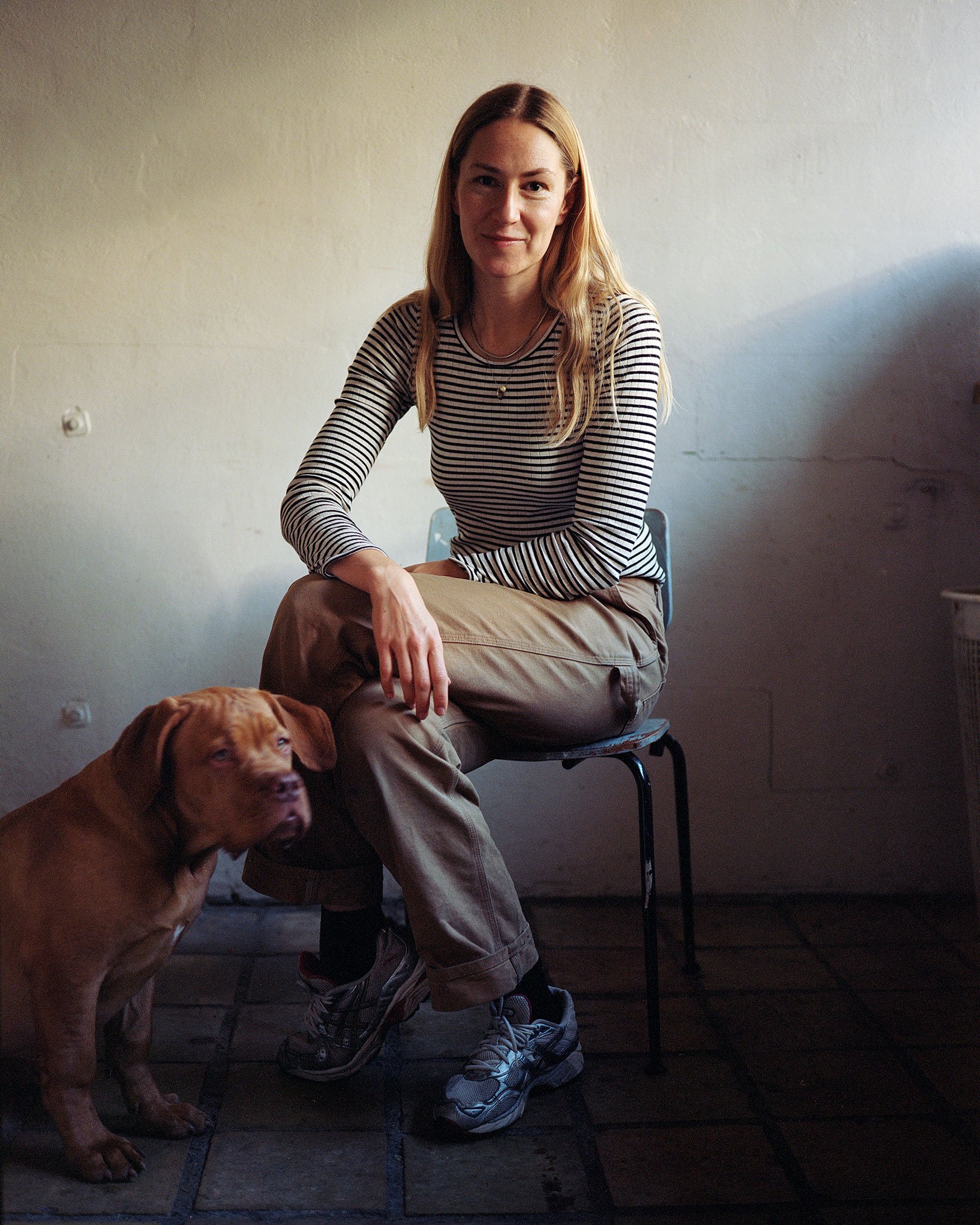
Tine Bek. Photo: Paula Duvå
You’ve become a mother for the second time. Has motherhood changed what you notice?
My daily life has changed, and so have the things I encounter and notice. When I play with my daughter, I see how something I take for granted can be completely new to her. She hasn’t yet decided what’s interesting and what she can simply walk past. It reminds me to keep looking.
Having children also makes you very aware of time. They’re constantly changing, and you can’t hold on to a particular age or way of being for very long. I recognise my own urge to preserve a moment, even though I know life keeps moving. That’s very close to what draws me to photography.
Your film Heste/Huller (Horses/Holes) shows horses underwater. How did it become a film about grief?
I’d wanted to film horses underwater for a long time and had been following the work of a rehabilitation centre in Ikast. There was something strange and compelling about those large bodies swimming and walking on an underwater treadmill. The muscles, the foam and the repeated movements were almost meditative.
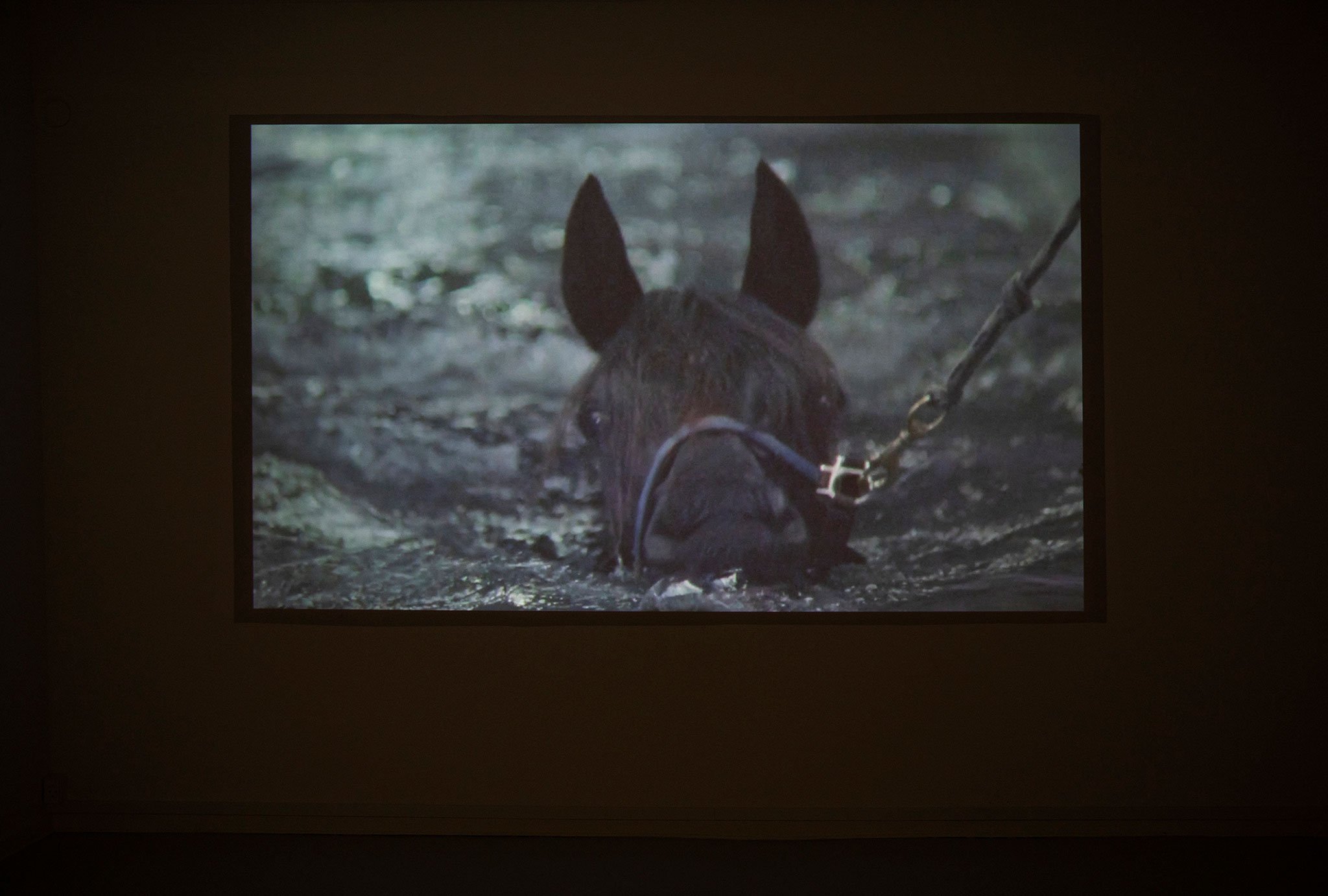
Tine Bek: Heste/Huller (Horses/Holes). Foto: Arden Asbæk
For me, Heste/Huller became a film about grief because I’d just lost my father. I could see strength and helplessness in the same body. I associate the title with the feeling of being pulled underwater and suddenly losing control of your own movements. You have to let go to get back to the surface.
Grief has a similar force. The film allowed me to approach that experience through the body and through rhythm. The horses’ movements could convey a feeling I found difficult to put into words.
Your 2024 exhibition This Ship is Unsinkable at Fotografisk Center took the Titanic as its starting point. What drew you to that story?
With the Titanic, there’s a sense of grandeur, but we already know it’s doomed. That tension was where the exhibition began. I was also interested in the 1997 film and the lines and images so many of us carry around in our heads.
When you put the title ‘King of the World’ alongside a figure made of pink butter, that sense of triumph suddenly rests on something very fragile. I’m interested in that because I recognise our need to feel secure and to hold on to a particular idea of the world. We build our own versions of the unsinkable. With butter, that idea is quite literally in danger of losing its shape.
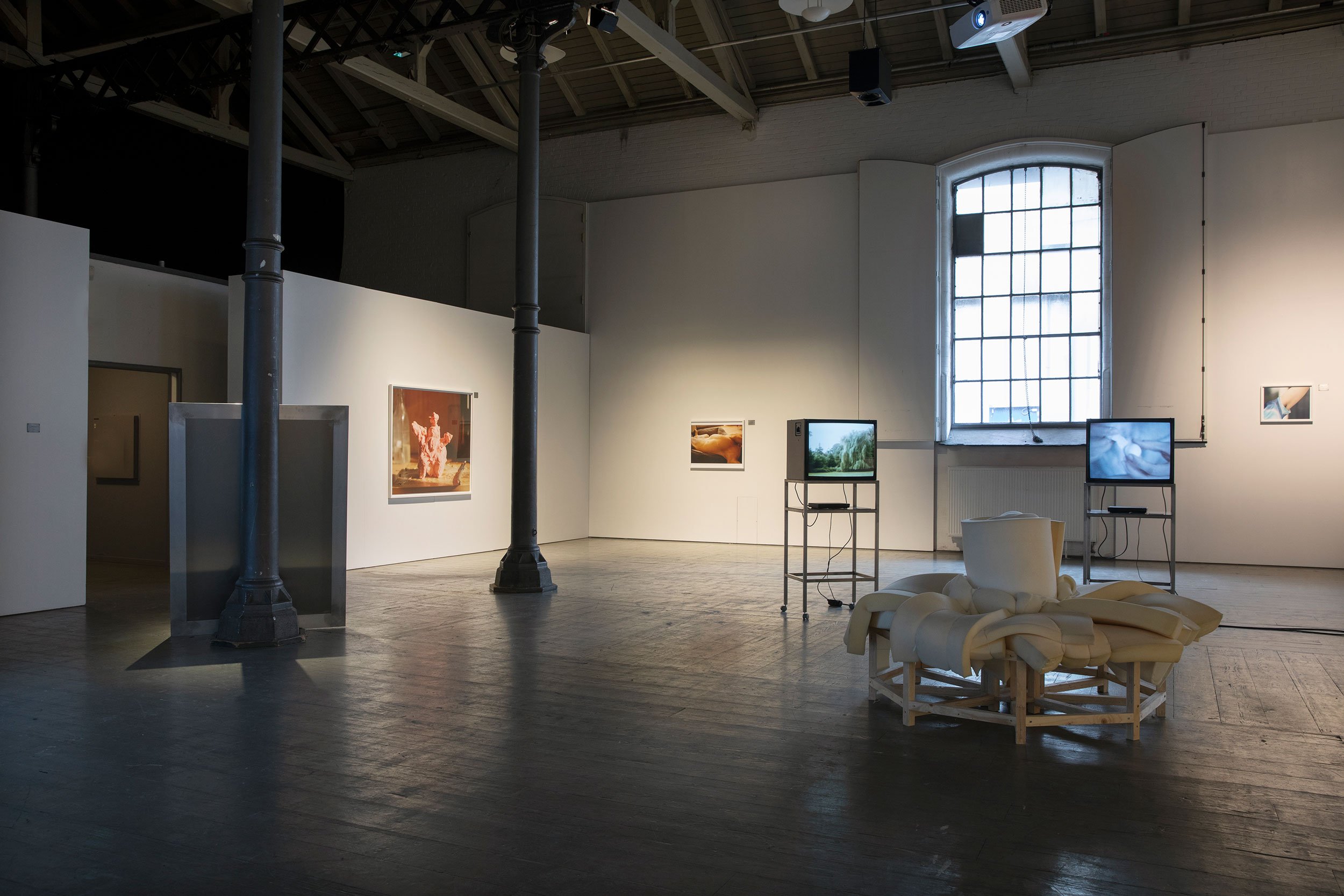
Exhibition view Tine Bek: This Ship is Unsinkable at Fotografisk Center, 2024. Credit: Tine Bek
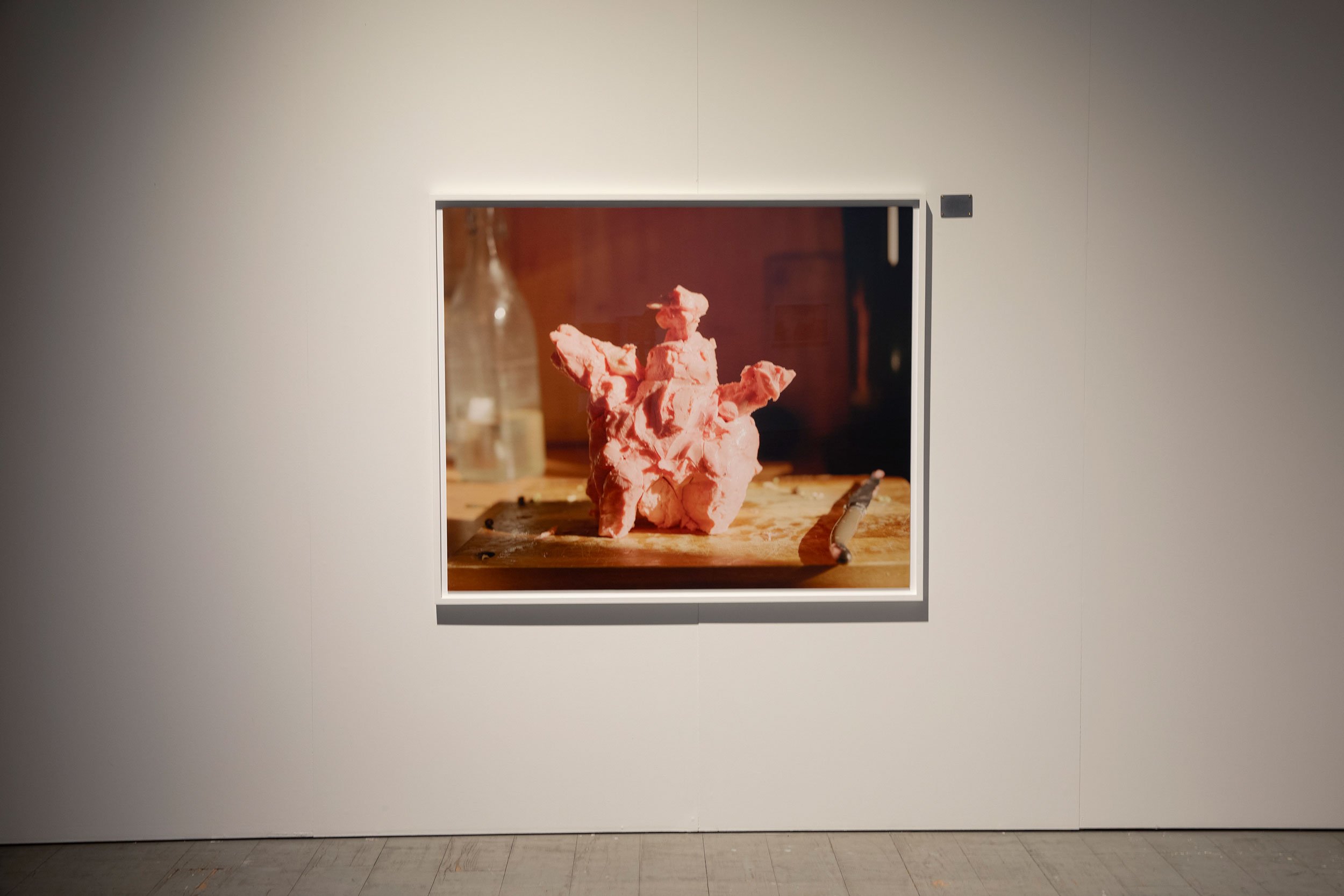
Exhibition view Tine Bek: This Ship is Unsinkable at Fotografisk Center, 2024. Credit: Tine Bek
What could you explore in the exhibition space that you couldn’t in a single photograph?
At Fotografisk Center, I explored how viewers moved through the space and the difference between seeing an object and seeing a photograph of it. You can walk up to a sculpture, take in its size and imagine its weight. A photograph lets you approach it differently: the viewpoint has already been chosen for you.
Bringing the two together makes those differences tangible. A small object can have an enormous presence in a photograph. Something that looks solid in a picture can turn out to be fragile when you see it in the room. Those shifts make me more aware of how much a photograph shapes what we see, and the exhibition gives me a way to explore that relationship further.
You also shoot fashion and take on commercial commissions. What do you get from that work?
It gives me the chance to develop ideas with other people. There’s a brief, an art director and a set of constraints, and I have to find my own response to them. I learned a lot from that exchange. Someone else’s idea can lead me to a picture I would never have imagined on my own.
I bring the same fascination with bodies, fabrics and surfaces to that work. I’m drawn to beautiful things and can become completely absorbed in the shape of a make-up product or an accessory. On a commercial shoot, that fascination becomes part of a shared process, with people from different disciplines helping to shape the final image.
I try to let the moment unfold and notice the small gestures.
Tine Bek
What does an honest portrait mean to you?
A portrait that conveys something of the person’s own way of being. I like photographing people at home or in their workplace. There are already relationships between them and the rooms and objects around them, and I can pay attention to those.
I try to let the moment unfold and notice the small gestures. A pause, or the way someone rests a hand, can tell you a great deal. I also have to let go of my own idea of how the person should look, to leave room for something I hadn’t imagined.
You run Foto Studio with fellow artists Paula Duvå and Mads Holm, organising talks and curating exhibitions. How does that connect with your own practice?
I’m interested in what photography can do, and in the assumptions that hold it back. Those questions become more interesting when you explore them with other people. It also goes back to something I learnt in Glasgow: you can help create the conversations and opportunities you feel are missing.
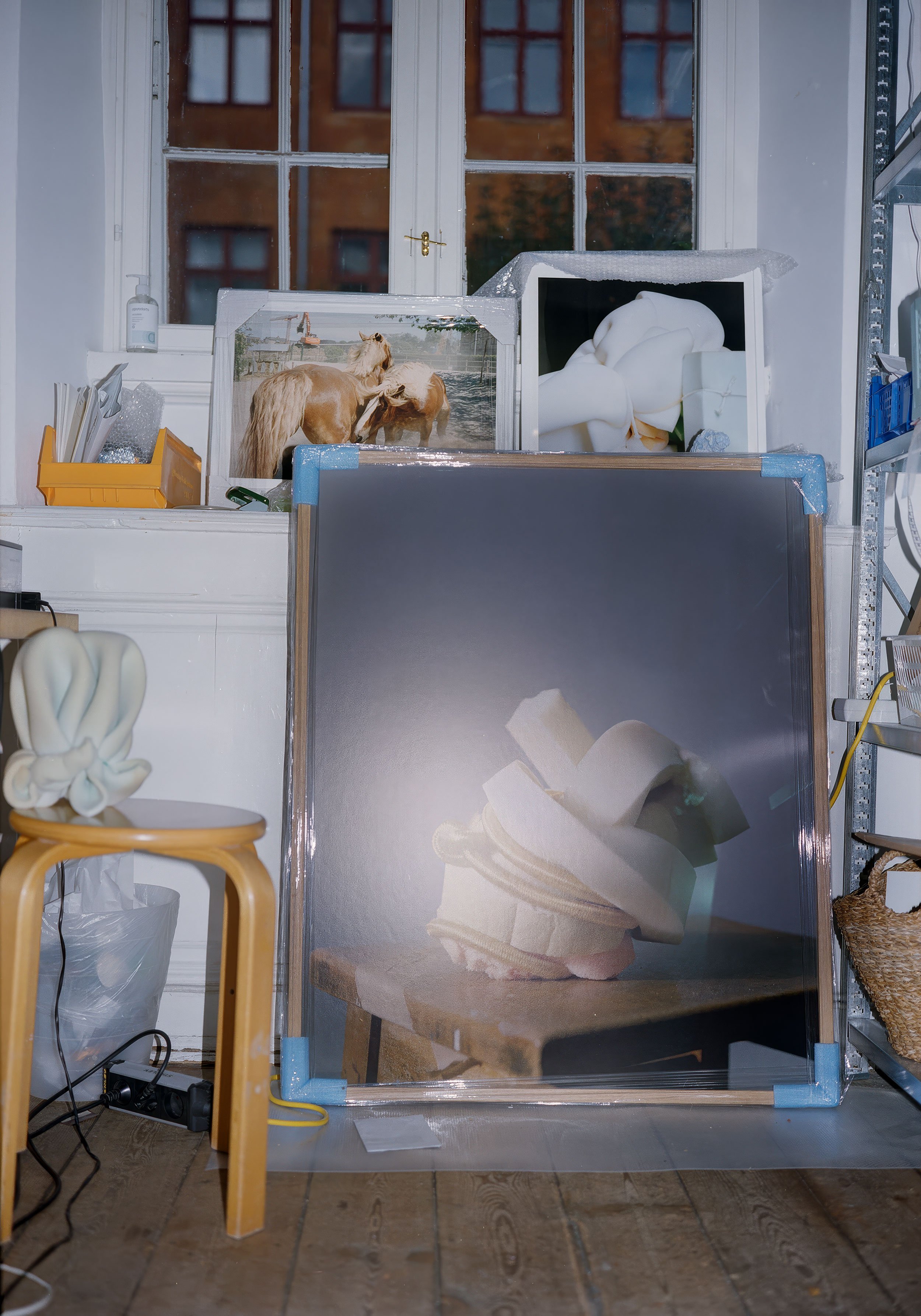
From Tine Bek's studio. Photo: Paula Duvå
At Foto Studio we organise conversations, write texts and curate exhibitions. This year, we’re co-curating Ung dansk fotografi (Young Danish Photography) at Fotografisk Center. We selected the participants through an open call that attracted more than 300 applicants. It gave us a chance to see the many different forms a photographic practice can take today.
We’ve also organised three talks. The first is with Katy Hundertmark from Foam, the photography magazine based in Amsterdam, and focuses on care and photography. I think it’s important to ask how care can shape the way we look through a camera. The history of photography is full of powerful ideas about the war photographer, and the photographer who takes a picture and moves on. I want to broaden that conversation and make room for other ways of being present with a camera.
What makes you reach for your camera at the moment?
In the spring, I showed a series of works at Annika Nuttall Gallery exploring the colour yellow. Now I’m drawn to purple, perhaps as a continuation of that exhibition. I keep photographing wisteria and finding connections between pictures through colour. Sometimes that’s how a project begins, before I know what it will become. A colour makes me look again, and gradually things come together, leading to a new photograph.